

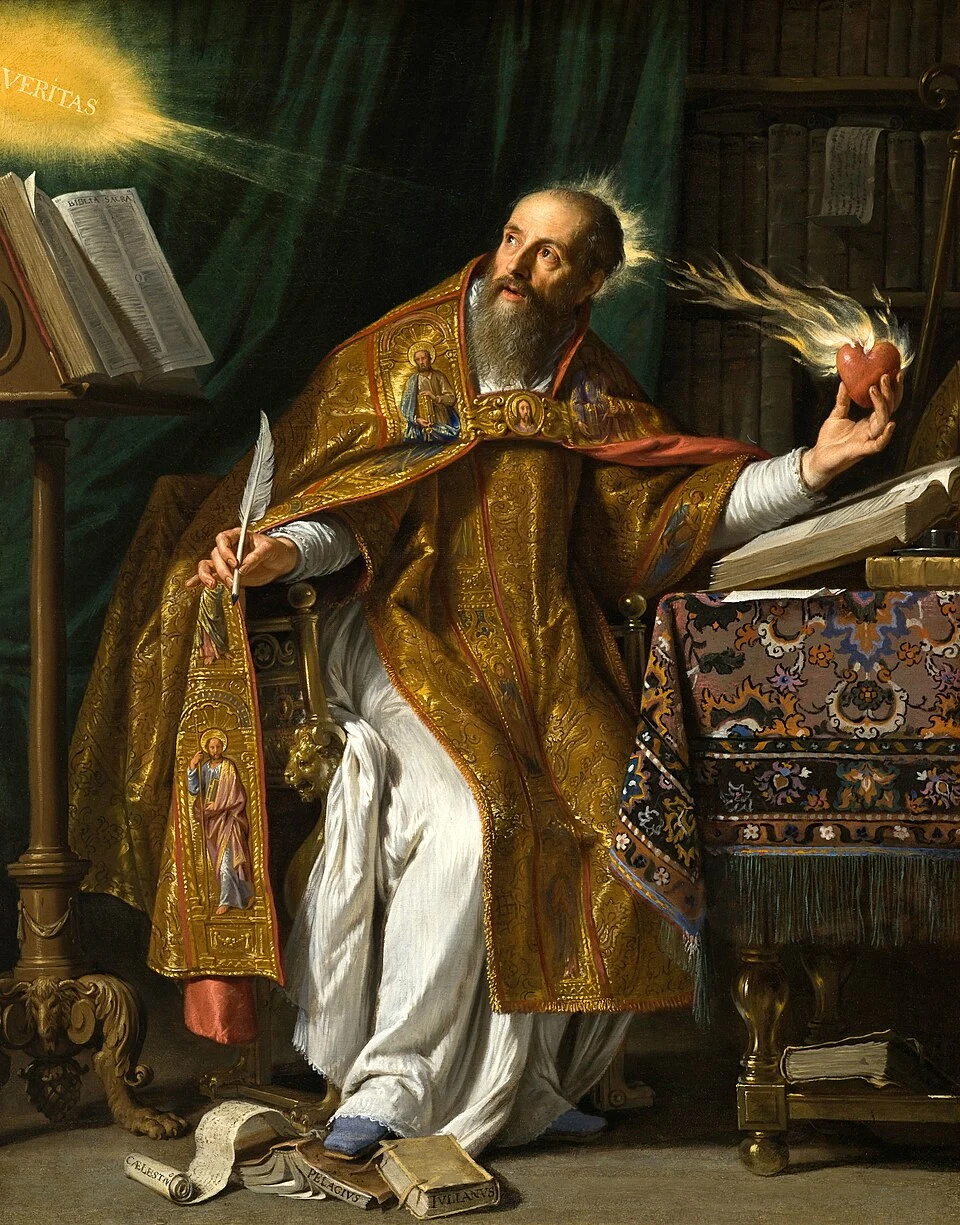
Aurelius Augustinus was born on November 13, 354, in Thagaste, a small town in the Roman province of Numidia, in what is now Algeria. His father Patricius was a pagan of modest means who converted to Christianity shortly before his death; his mother Monica was a devout Christian whose prayers and tears for her son's conversion would become legendary. Augustine received a classical Roman education in rhetoric and literature, first in nearby Madauros, then in Carthage, where his father's sacrifices and a benefactor's generosity made advanced study possible. Carthage was a cosmopolitan city that offered both intellectual stimulation and moral temptation. Augustine excelled in his studies but also embraced the sexual freedoms of student life, taking a concubine with whom he lived faithfully for fifteen years and who bore him a son, Adeodatus.
His intellectual hunger led him to the Manichees, a dualistic sect that promised rational answers to the problem of evil and claimed to offer pure Christianity freed from Jewish corruptions. For nine years Augustine remained a Manichaean "hearer," drawn by their apparent sophistication and their dismissal of the crude anthropomorphisms he found in Scripture. But gradually their promises proved hollow. When he finally encountered Faustus, a celebrated Manichaean bishop, Augustine found him eloquent but unable to answer serious questions.
In 383 Augustine sailed to Rome, and then to Milan, where he had secured a prestigious position as imperial rhetorician. Milan changed everything. There he encountered Ambrose, the bishop whose allegorical interpretation of Scripture dissolved Augustine's intellectual objections to Christianity. More troubling was the growing conviction that his will was enslaved to habits he could not break. The famous scene in the garden came in July 386: hearing a child's voice chanting "take up and read," Augustine opened Paul's letter to the Romans and found the verse that shattered his resistance. "Not in orgies and drunkenness, not in sexual immorality and debauchery, not in dissension and jealousy. Rather, clothe yourselves with the Lord Jesus Christ, and do not think about how to gratify the desires of the flesh." He was thirty-one.
Ambrose baptized Augustine at Easter 387, along with his son Adeodatus and his friend Alypius. Augustine returned to North Africa intending to establish a philosophical community devoted to Christian contemplation, but the church had other plans. In 391, while visiting the port city of Hippo Regius, he was forcibly ordained priest by popular acclamation. Four years later he became bishop, a position he held until his death. His episcopate coincided with the decline of Roman power in Africa and the rise of theological controversies that would define Latin Christianity for centuries.
His Writing and Theological Legacy
Augustine began writing soon after his conversion, producing philosophical dialogues that explored the relationship between faith and reason. But it was the Confessions, completed around 400, that established his voice and method. Written as an extended prayer to God, it combined autobiography with theology in a way that was entirely new, tracing the restless movement of the soul toward its source. The work established Augustine as the great psychologist of Christian experience, mapping the interior landscape of conversion, memory, and desire with unprecedented precision.
The next three decades brought an extraordinary outpouring of writing. The City of God, written in response to the sack of Rome in 410, constructed a vast theology of history that distinguished between earthly and heavenly cities, arguing that Christians owed ultimate allegiance not to any earthly empire but to the eternal city of God. His biblical commentaries, especially on Genesis and the Psalms, shaped how Latin Christianity read Scripture for a millennium. His anti-Pelagian writings developed the theology of grace that would become central to Western Christianity, insisting against Pelagius that human nature was so corrupted by original sin that salvation required divine initiative rather than human effort.
Three great controversies defined his theological development. Against the Manichees, he defended the goodness of creation and developed his understanding of evil as privation rather than substance. Against the Donatists, a North African sect that claimed to be the only pure church, he articulated a theology of the church as a mixed body of saints and sinners, and defended the validity of sacraments administered by unworthy clergy. Against the Pelagians, he developed his mature doctrine of grace, arguing that the human will, corrupted by Adam's fall, required divine grace not merely to act well but even to desire the good.
Augustine died on August 28, 430, as Vandal armies besieged Hippo. His influence on Western Christianity is difficult to overstate. Medieval scholastics called him "the theologian" without qualification. The Reformers claimed him as the doctor of grace. Modern psychology recognizes him as the inventor of the introspective self. But perhaps his most enduring contribution was his integration of biblical faith with classical learning, creating a synthesis that made it possible for Christianity to inherit and transform the intellectual tradition of antiquity.
Works by Augustine of Hippo
Begin with the Confessions, his own story told as a prayer to God. Then read the Enchiridion, his whole faith in a short handbook, and the Ten Homilies on the First Epistle of John for his preaching. The City of God and On the Trinity are the great long works; On Christian Doctrine is for readers of the Bible, and On the Spirit and the Letter opens his teaching on grace.
- Letters 386 – 430
- Soliloquies 386 – 387
- Sermons 391 – 430
- Sermons on Scripture 391 – 430
- Expositions on the Psalms 392 – 422
- On Lying 395
- On Christian Doctrine 396 – 426
- Confessions 397 – 400
- Against Faustus the Manichean 397 – 398
- On the Trinity 399 – 419
- Tractates on the Gospel of John 406 – 420
- City of God 413 – 426
- On Patience 417 – 420
- On the Soul and its Origin 419 – 420
- On Marriage and Concupiscence 419 – 421
- On the Care to Be Had for the Dead 421 – 422
Disputed works
Works that have circulated under Augustine of Hippo’s name. Disputed: scholars question whether Augustine of Hippo wrote it.
Printed among his works and on the Augustinus.it list, but not named in the Retractations; often judged a compilation from his writings.
Influence
Who shaped Augustine of Hippo, and who Augustine of Hippo shaped, and who worked beside Augustine of Hippo. Each line is drawn from the research behind the catalogue; the evidence sits in the catalogue, not on this page.
Influenced by
- Plato 427 BCE–347 BCE through City of God
- Philo of Alexandria 20 BCE–50 through Against Faustus the Manichean
- Irenaeus of Lyons 130–202 through Against Heresies
- Cyprian of Carthage 200–258
- Plotinus 204–270 through City of God
- Porphyry 234–305 responded to through City of God
- Anthony the Great 251–356
- Athanasius of Alexandria 296–373 through Life of Antony
- Hilary of Poitiers 310–367 through On the Trinity
- Ambrose of Milan 340–397 was taught by through Confessions
- Jerome 347–420 responded to through Letters
- John Chrysostom 349–407
- Pelagius responded to
Influenced
- Orosius 375–418
- Prosper of Aquitaine 390–455
- Boethius 480–524
- Gregory the Great 540–604
- Anselm of Canterbury 1033–1109 through Monologion
- Peter Lombard 1100–1160 through On Christian Doctrine
- Bonaventure 1217–1274
- Thomas Aquinas 1225–1274 through On the Trinity
- Meister Eckhart 1260–1328 through Commentary on Genesis
- Dante Alighieri 1265–1321
- John Wycliffe 1330–1384
- Jan Hus 1372–1415 through On the Church
- Thomas More 1478–1535
- Martin Luther 1483–1546 through Bondage of the Will
- John Calvin 1509–1564
- John Knox 1514–1572 through Answer to a Great Number of Blasphemous Cavillations
- Teresa of Ávila 1515–1582 through Life of Teresa of Jesus
- Lambert Daneau 1530–1595
- John of the Cross 1542–1591
- John Donne 1572–1631 through LXXX Sermons
- Blaise Pascal 1623–1662
- Romano Guardini 1885–1968
- T. S. Eliot 1888–1965 through Waste Land
- Reinhold Niebuhr 1892–1971
- Henri de Lubac 1896–1991 through Augustinianism and Modern Theology
- C. S. Lewis 1898–1963 through Four Loves
- Bernard Lonergan 1904–1984
- Joseph Ratzinger (Benedict XVI) 1927–2022
- Peter Kreeft 1937–?
- Oliver O'Donovan 1945–? through Problem of Self-Love in St. Augustine
- John Piper 1946–?
- Rowan Williams 1950–?
- James K. A. Smith 1970–? through On the Road with Saint Augustine
Worked with
- Paulinus of Nola 354–431
Resources
Catalog IDA.1F0632.X