

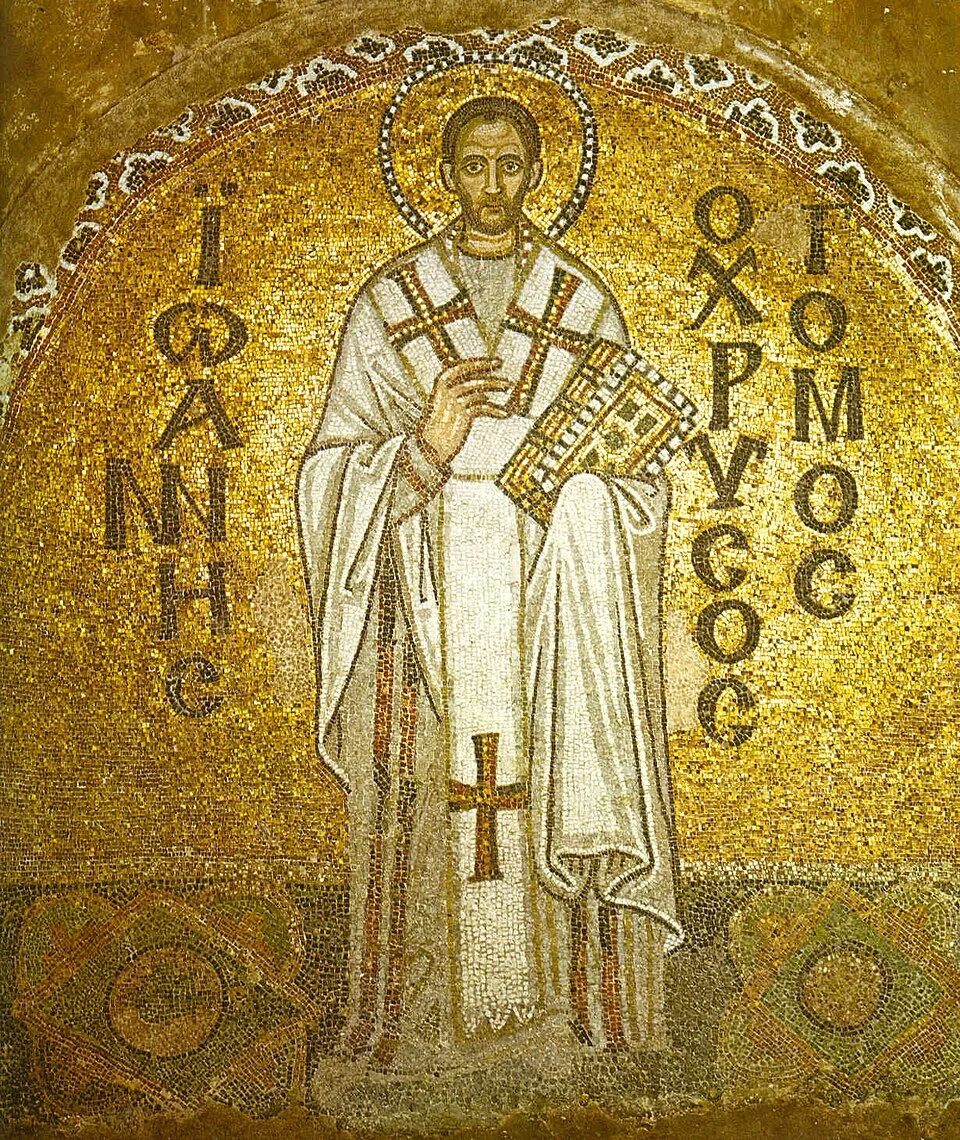
Public domain
John Chrysostom
349 – 407
Also known as: John of Antioch, Chrysostomus, Saint John Chrysostom, Golden-mouthed, Johannes Chrysostomos
Patristic — Pastoral Theology
John Chrysostom was born around 349 in Antioch, the great commercial and intellectual center of the Eastern Roman Empire. His father Secundus, a high-ranking military officer, died when John was young, leaving his upbringing to his mother Anthusa, a Christian woman whose devotion and intelligence shaped his early formation. She provided him with the finest classical education available, studying rhetoric under Libanius, the most celebrated pagan orator of the age. Libanius later remarked that John would have been his successor "if the Christians had not stolen him from us."
After his baptism around age eighteen, John felt drawn toward the ascetic life that was flourishing in the mountains outside Antioch. Despite his mother's tearful appeals that he not abandon her as his father had in death, he eventually spent six years in monastic communities, including two years as a hermit in a cave. The extreme asceticism damaged his health permanently, forcing his return to Antioch around 378. There he was ordained deacon in 381 and priest in 386 by Bishop Meletius, beginning the preaching ministry that would earn him the name Chrysostom — "Golden-mouthed."
For twelve years John preached regularly in Antioch's churches, developing the expository method and moral urgency that made him the greatest preacher of the early church. His sermons were biblical expositions delivered with rhetorical brilliance but without rhetorical showiness — he had transformed his classical training into a tool for opening Scripture. The congregation often interrupted with applause, which he discouraged, saying he preferred the applause of changed lives to the applause of entertained ears.
In 398, against his will, John was essentially kidnapped and brought to Constantinople to serve as archbishop. The imperial capital's wealth, corruption, and ecclesiastical politics were foreign to his ascetic sensibilities and direct manner. He immediately began reforms: selling the ornate furnishings of the episcopal palace to fund hospitals, ending the lavish entertaining that his predecessor had made customary, and preaching against the excesses of the wealthy with the same fearless specificity he had used in Antioch. When Empress Eudoxia erected a silver statue of herself near the cathedral with pagan ceremonies, John denounced it from the pulpit, allegedly comparing her to Herodias. The sermon cost him everything.
A coalition of enemies had been building against him — rival bishops jealous of his influence, clergy resentful of his reforms, aristocrats stung by his preaching. Theophilus of Alexandria, nursing old grievances, provided theological cover by convening the illegal Synod of the Oak in 403, which condemned John on fabricated charges. Eudoxia pressured her husband Emperor Arcadius to exile him. Popular riots secured John's brief return, but within months he was exiled again, this time permanently. He spent his final three years in increasingly remote locations, continuing to write letters of encouragement to his supporters until guards forced him on a final march that killed him in 407. His last words were "Glory to God for all things."
His Writing and Influence
Chrysostom's literary legacy rests primarily on his homilies — over six hundred authentic sermons survive, constituting the largest body of preaching from the early church. His exegetical method was straightforward: explain what the text says, then apply it to Christian living with relentless moral clarity. He avoided the allegorical interpretations favored by Alexandrian theologians, preferring the literal sense developed by the Antiochene school. His expositions of Matthew, John, Romans, and other biblical books remain models of pastoral preaching — learned but accessible, deeply scriptural but immediately practical.
The homilies reveal a preacher unafraid to name specific sins of his congregation. He denounced the theater, the races, and the elaborate clothing of the wealthy with equal vigor. His famous series "On Vainglory and the Right Way for Parents to Bring Up Their Children" provided detailed guidance for Christian formation in the home. His "Six Books on the Priesthood," written early in his career, became a foundational text for clerical formation, examining the spiritual and practical challenges of pastoral ministry with psychological insight and theological depth.
Chrysostom's influence on Eastern Christianity was immediate and lasting. Within thirty years of his death, he was rehabilitated and his relics returned to Constantinople with imperial honors. His liturgical reforms shaped the Divine Liturgy that still bears his name in Eastern Orthodox worship. Medieval Byzantine preachers measured themselves against his standard. In the West, his works were translated and studied throughout the medieval period, influencing reformers who found in his moral clarity and biblical focus a model for their own preaching.
Works by John Chrysostom
Begin with On the Priesthood, six books of dialogue on what the care of souls costs, the most read of his works and the shortest way to the man. Then the Homilies on the Statues, twenty-one sermons preached to Antioch as it waited to be punished for a riot, and the Sermon on the Mount homilies from the Matthew series (Homilies 15-24). The great expository series on Matthew, John, Acts and the Pauline letters are for dipping into; the Letters to Olympias, from exile, last.
- Letter to a Young Widow 380 – 381
- On the Priesthood 386 – 390
- Homily on St Babylas 386 – 397
- Occasional Homilies 386 – 404
- Homilies on Colossians 386 – 397
- Homilies on Philemon 386 – 404
- Homilies on Titus 386 – 397
- Homilies on First Timothy 386 – 404
- Homilies on Second Timothy 386 – 404
- Homilies on the Gospel of John 386 – 407
- Homily on St Ignatius 386 – 397
- Baptismal Instructions 388 – 390
- Homilies on First Corinthians 390 – 398
- Homilies on Second Corinthians 392 – 393
- Homilies on Ephesians 393 – 397
- Commentary on Galatians 393 – 397
- Homilies on Philippians 398 – 404
- Homilies on First Thessalonians 398 – 404
- Homilies on Second Thessalonians 398 – 404
- Homilies on Hebrews 403 – 404
- Letters 404 – 407
Disputed works
Works that have circulated under John Chrysostom’s name. Disputed: scholars question whether John Chrysostom wrote it.
The short Easter sermon read at every Orthodox Paschal liturgy under Chrysostom's name; printed by Migne among the spuria, and most scholars doubt it is his. Suggested attribution: disputed - the liturgical ascription is universal, the scholarly consensus against it; the description should say so.
Influence
Who shaped John Chrysostom, and who John Chrysostom shaped. Each line is drawn from the research behind the catalogue; the evidence sits in the catalogue, not on this page.
Influenced by
- Libanius 314–393 was taught by
- Gregory of Nazianzus 329–390 through Oration 2: In Defense of His Flight
- Diodore of Tarsus was taught by
Influenced
- Theodore of Mopsuestia 350–428
- Augustine of Hippo 354–430
- John Cassian 360–435 taught
- Nilus of Sinai 360–430
- Theodoret of Cyrus 393–458
- John of Damascus 675–749
- Thomas Aquinas 1225–1274 through Homilies on the Gospel of Matthew
- Desiderius Erasmus 1466–1536
- John Calvin 1509–1564 through Homilies on the Epistle to the Romans
- John Henry Newman 1801–1890
Appears in these collections
- Bible Reading What role does reading the Bible play in the life of a believer? (listed as an author)
- Prayer What is prayer? (listed as an author)
Resources
- Catholic Encyclopedia (1910): St. John Chrysostom Biography
- W. R. W. Stephens, Saint John Chrysostom, His Life and Times (1872) Biography
- CCEL: NPNF1-09, Chrysostom: On the Priesthood, Ascetic Treatises, Select Homilies and Letters, Homilies on the Statues (1889) Primary source
- The Tertullian Project: Additional Fathers - John Chrysostom Primary source
Catalog IDA.0PZGYG.R