

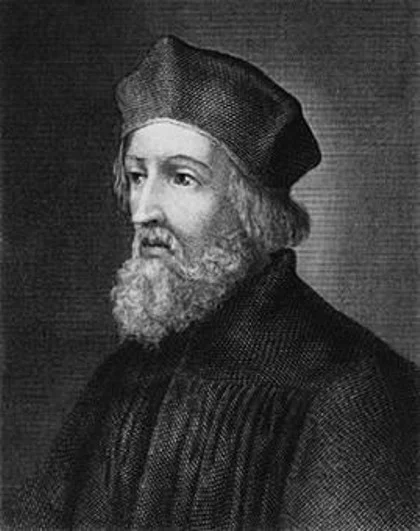
Public domain · Research complete
Jan Hus
1372 – 1415
Also known as: Johannes Hus, John Huss, Master Jan Hus
Pre-Reformation — Reform/Theology
Jan Hus was born at Husinec in southern Bohemia around 1370; the year is not known, and his biographers place it anywhere from 1369 to 1375. As a poor student at Prague he supported himself by singing and serving in the churches. He took his bachelor's degree at the University of Prague in 1393 and his master's in 1396, was ordained a priest about 1400, and in 1402 became preacher at the Bethlehem Chapel, founded in the city for preaching in Czech. He was rector of the university more than once, the last time from 1409.
From the Bethlehem pulpit he attacked the lives of the clergy, and in the university he took the side of the Czech masters; he was deeply influenced by the writings of John Wyclif. When Archbishop Zbyněk had Wyclif's books burned in 1410 and restricted preaching, Hus protested, and in July 1410 the archbishop excommunicated him; the papal court did the same in 1411. In 1411 and 1412 he opposed the bulls of Pope John XXIII that offered indulgences to all who gave money for a crusade against King Ladislaus of Naples, and disputed against them in the university in June 1412. The sentence against him was renewed, Prague was placed under interdict while he stayed there, and in October 1412 he left the city. For two years he lived in the castles of friends in the Bohemian countryside, chiefly Kozí Hrádek, writing his book On the Church and much of his work in Czech.
In 1414 he agreed to answer for his teaching before the Council of Constance under a safe-conduct from King Sigismund. He reached Constance on 3 November and was arrested on 28 November. At his hearings in June 1415 he said he was ready to be taught by the council, but would not abjure articles he had never held, since that would be to lie against his conscience. On 6 July 1415 the council condemned him as a heretic and he was burned at Constance. The eyewitness Peter of Mladoňovice reports that he died singing "Christ, Son of the living God, have mercy on me."
His Writing and Influence
Hus wrote in Latin and in Czech. His Latin works include lectures on Peter Lombard's Sentences, given from 1407, whose teaching Count Lützow found entirely in accord with the Roman Church of the time; early treatises on the body and blood of Christ, the second written for the archbishop's inquiry into the bleeding hosts of Wilsnack; university disputations and sermons; and the controversial writings of 1412 and 1413. The chief of these is On the Church, which follows Wyclif's book of the same name closely, often word for word, and holds that the church is the whole company of those God has predestined, with Christ its only head. Replies to Stanislav of Znojmo, Stephen Páleč and the eight doctors of the theological faculty carry on its argument. In Czech he wrote expositions of the Creed, the Ten Commandments and the Lord's Prayer, the short devotional book The Daughter, the book On Simony, which treats the buying and selling of spiritual things as a heresy, and the Postil, sermons on the Sunday gospels with the gospel text set before each so that people without a Czech gospel could hear it. Many of his letters survive, the last of them written in prison at Constance.
The Council of Constance drew many of the articles on which it condemned him from On the Church. His followers in Bohemia kept his memory through decades of conflict, and a century later Martin Luther wrote to Spalatin in February 1520 that "we are all Hussites without knowing it."
Works by Jan Hus
Begin with The Letters of John Hus, above all those from his prison at Constance, in Workman and Pope's free 1904 English translation. Then read On the Church, his defence of what the church is, in David Schaff's 1915 translation. On Simony, his Czech book on the trade in spiritual things, is in English only in a lending copy.
- University Disputed Questions 1400 – 1412
- On the Body of Christ 1405 – 1409
- Lectures on the Psalms 1405 – 1407
- Commentary on the Four Books of Sentences 1407 – 1409
- The Letters of John Hus 1408 – 1415
- Against a Hidden Adversary 1409 – 1411
- Exposition of the Ten Commandments 1409 – 1411
- On Reading the Books of Heretics 1410 – 1411
- Defence of Wyclif's Book on the Trinity 1410 – 1412
- Sermons in the Bethlehem Chapel 1410 – 1411
- Against John Stokes 1411
- The Daughter 1412
- On Simony 1413
- Postil 1413 – 1414
- On Receiving the Blood under the Form of Wine 1414 – 1415
- Sermon on Peace 1414
- On Marriage 1415
- On Mortal Sin 1415
- On Penance 1415
Disputed works
Works that have circulated under Jan Hus’s name. Disputed: scholars question whether Jan Hus wrote it.
Printed among Hus's Czech works by Erben (vol. III, 'Katechismus'), but D. S. Schaff (John Huss, 1915, preface) calls the catechism in Palacký's Documenta Hus's 'alleged catechism'.
- Hymns Disputed
Erben prints a group of hymns among Hus's Czech works, and Hus names his own song 'Jezu Kriste, štědrý kněže' in the Postil (Erben III, p. 345); Count Lützow (1909) says the authorship of most of the hymns ascribed to him is uncertain.
Influence
Who shaped Jan Hus, and who Jan Hus shaped. Each line is drawn from the research behind the catalogue; the evidence sits in the catalogue, not on this page.
Influenced by
- Augustine of Hippo 354–430 through On the Church
- Peter Lombard 1100–1160 through Commentary on the Four Books of Sentences
- Bonaventure 1217–1274 through Commentary on the Four Books of Sentences
- Thomas Aquinas 1225–1274 through Commentary on the Four Books of Sentences
- Thomas Bradwardine 1290–1349 through Commentary on the Four Books of Sentences
- John Wycliffe 1330–1384 through On the Church
Influenced
- Martin Luther 1483–1546
Resources
Catalog IDA.YF71PW.0