

Public domain
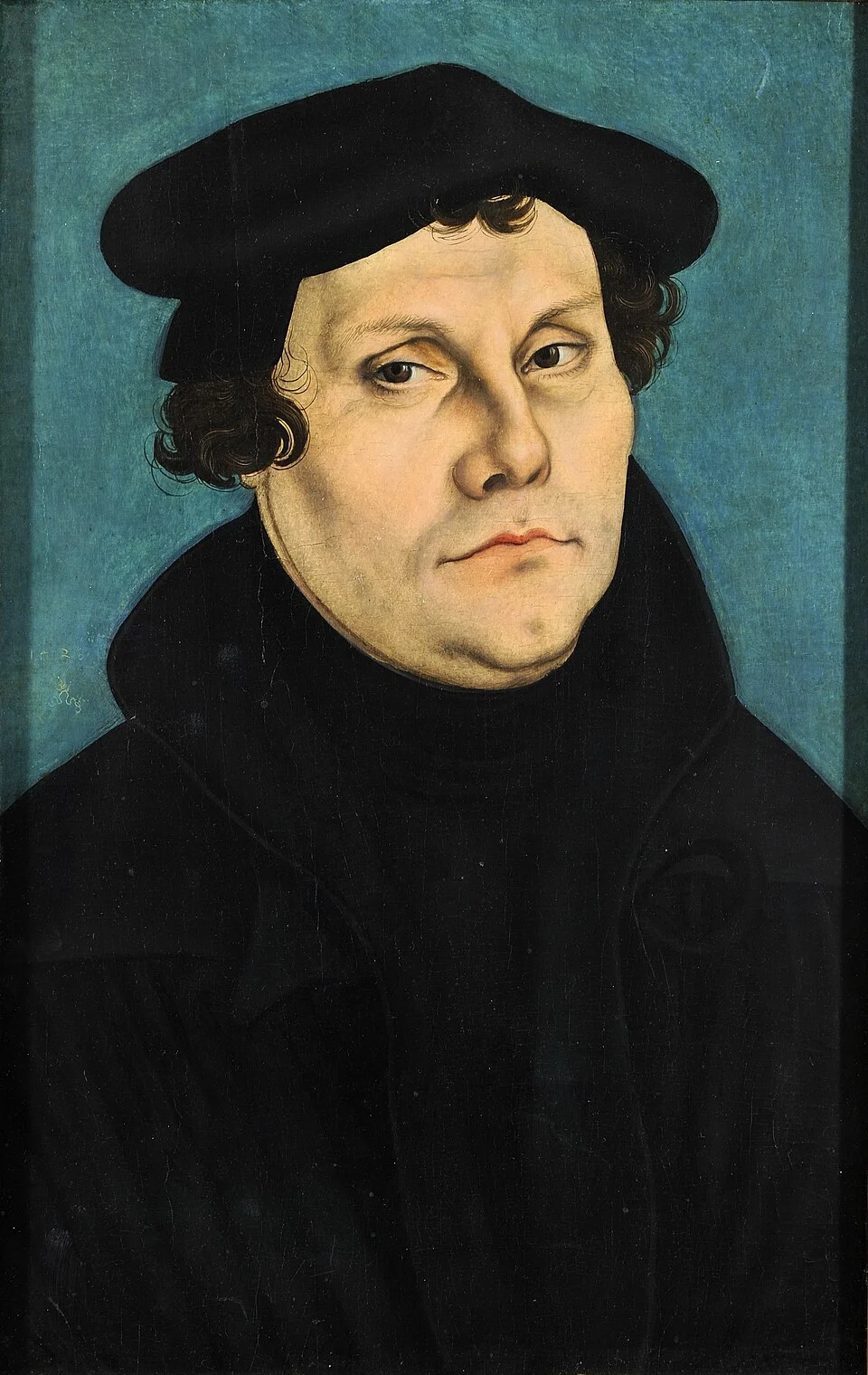
Martin Luther
1483 – 1546
Also known as: Martinus Lutherus, Martin Luder, Doctor Martinus
Lutheran — Theology/Reformation
Martin Luther was born November 10, 1483, in Eisleben, in the Holy Roman Empire, the son of Hans Luder, a copper miner who later became a successful entrepreneur in the mining business. His father harbored ambitions for his son's advancement and sent him to the University of Erfurt in 1501 to study law. But on July 2, 1505, caught in a violent thunderstorm near Stotternheim, Luther cried out to Saint Anne and vowed to become a monk if he survived. Two weeks later, against his father's furious opposition, he entered the Augustinian monastery at Erfurt.
The monastic life intensified rather than resolved Luther's spiritual struggles. He threw himself into the disciplines of prayer, fasting, and confession with such severity that his superiors worried about his health. Johann von Staupitz, his confessor and mentor, recognized both Luther's brilliance and his torment, steering him toward academic work and eventually ordination. Luther was ordained a priest in 1507 and began theological studies, earning his doctorate in 1512. That same year he joined the faculty at the University of Wittenberg, where he would spend the remainder of his career lecturing on Scripture.
It was in his academic work on the Psalms and Paul's epistles that Luther's evangelical breakthrough occurred, likely between 1513 and 1515. Wrestling with Romans 1:17 and the phrase "the righteousness of God," Luther came to understand that this righteousness was not God's demand upon sinners but God's gift to them through faith in Christ. The discovery transformed his understanding of justification and would become the theological cornerstone of the Protestant Reformation. When Johann Tetzel arrived near Wittenberg in 1517 selling indulgences with the promise that payment could release souls from purgatory, Luther's pastoral conscience was provoked. On October 31, 1517, he posted his Ninety-Five Theses on the castle church door, intending to spark academic debate about indulgences and penance.
The theses spread rapidly across Germany, and what Luther had intended as scholarly disputation became a popular movement. The ensuing controversies drew him deeper into conflict with Rome. At the Leipzig Debate in 1519, Luther was forced to acknowledge that he considered some of the propositions of Jan Hus, condemned as heretical, to be Christian truth. By 1520 he had published three reformatory treatises that laid out his theology in full: "To the Christian Nobility of the German Nation," "The Babylonian Captivity of the Church," and "The Freedom of a Christian." Pope Leo X issued the bull Exsurge Domine, giving Luther sixty days to recant or face excommunication. Luther burned the bull publicly in Wittenberg.
At the Diet of Worms in 1521, before Emperor Charles V and the assembled estates of the empire, Luther refused to recant his writings, reportedly concluding: "Here I stand, I cannot do otherwise. God help me. Amen." The emperor declared him an outlaw, but Luther's prince, Frederick the Wise of Saxony, arranged for his protective "kidnapping" to Wartburg Castle. During his ten months in hiding, Luther translated the New Testament into German, producing a work that would reshape both German literature and popular access to Scripture. He returned to Wittenberg in 1522 to restore order after radical reforms had created civic unrest.
Luther married Katharina von Bora, a former Cistercian nun, in 1525. Their marriage, which produced six children, became a model for Protestant family life and ended centuries of clerical celibacy in the reforming churches. But 1525 also marked Luther's harsh response to the Peasants' War, in which he urged the princes to suppress the rebellion violently, a position that damaged his reputation among common people and revealed the conservative social implications of his theology.
His Writing and Its Influence
Luther was among the most prolific authors in history, producing an estimated 2,500 works that fill over a hundred volumes in modern critical editions. His output included biblical commentaries, theological treatises, controversial writings, pastoral works, hymns, and an enormous correspondence. His German Bible, completed in 1534, established a literary standard for the German language and made Scripture accessible to ordinary readers in ways that transformed religious culture. His Small Catechism of 1529 became the basic instructional text for Lutheran Christianity, while his Large Catechism provided more detailed exposition for pastors and educated laypeople.
Luther's theological contributions centered on justification by faith alone, the authority of Scripture alone, and the priesthood of all believers. Against the medieval synthesis that coordinated Scripture, tradition, and papal authority, Luther insisted that Scripture alone possessed final authority in matters of faith. Against the sacramental system that made the church's priesthood essential for salvation, Luther argued that sinners were justified by faith in Christ's atoning work, received as pure gift. These insights, crystallized in controversy but rooted in his pastoral and exegetical work, became the foundation for Protestant Christianity.
The printing press made Luther the first reformer whose ideas could spread with unprecedented speed. His works were translated into Latin for international circulation and into vernacular languages across Europe. Within his lifetime, Lutheran churches had been established throughout Germany and Scandinavia. But Luther's influence extended beyond Lutheran circles; his challenge to papal authority and his recovery of Pauline soteriology shaped all subsequent Protestant theology. His translation principles influenced Bible translation across languages, and his hymns, including "A Mighty Fortress Is Our God," became central to Protestant worship.
Luther's later writings included increasingly harsh attacks on Jews, Turks, and papal Catholics that have complicated his legacy. His 1543 treatise "On the Jews and Their Lies" advocated violence against Jewish communities and was later appropriated by Nazi propagandists. These writings cannot be dismissed as peripheral to his theological work; they reveal how his theology of divine wrath, applied polemically, could justify terrible cruelties.
Luther died in Eisleben, his birthplace, on February 18, 1546, while attempting to mediate a dispute between local counts. His influence on Christian spiritual formation has been immense but complex. He recovered the evangelical core of Christian faith and made Scripture accessible to ordinary believers, but his polemical temperament and his political alliances also showed how reforming zeal could serve worldly power.
Works by Martin Luther
Begin with The Freedom of a Christian: short, and the whole of Luther in thirty sections — faith makes free, love makes a servant. Then The Small Catechism and The Large Catechism for what he taught a household, the Preface to the Epistle of St. Paul to the Romans for how he read Paul, and the Commentary on Galatians at length. Leave The Bondage of the Will till last.
- Letters 1507 – 1546
- Lectures on Romans 1515 – 1516
- Commentary on the First Twenty-Two Psalms 1519 – 1521
- Church Postil 1522 – 1544
- Hymns 1523 – 1545
- A Manual of the Book of Psalms 1531 – 1533
- Table Talk 1531 – 1546
- Lectures on Genesis 1535 – 1545
- House Postil 1544
About & Related Works
Works about Martin Luther, plus compilations, editions and commentary — offered as resources, not as their own writing.
Influence
Who shaped Martin Luther, and who Martin Luther shaped. Each line is drawn from the research behind the catalogue; the evidence sits in the catalogue, not on this page.
Influenced by
- Augustine of Hippo 354–430 through Bondage of the Will
- Bernard of Clairvaux 1090–1153
- Johannes Tauler 1300–1361
- Anonymous (Theologia Germanica) 1350–?
- Jan Hus 1372–1415
- Girolamo Savonarola 1452–1498 through Meditations on Psalm 51
- Desiderius Erasmus 1466–1536 responded to through Bondage of the Will
- Huldrych Zwingli 1484–1531 responded to
Influenced
- Desiderius Erasmus 1466–1536 was answered by through The Shield-Bearer
- Thomas More 1478–1535 was answered by through Response to Luther
- Huldrych Zwingli 1484–1531 was answered by through Friendly Exegesis
- Martin Bucer 1491–1551
- William Tyndale 1494–1536 through Preface to the Epistle of St. Paul to the Romans
- Philip Melanchthon 1497–1560
- Johannes Brenz 1499–1570
- John Calvin 1509–1564
- Martin Chemnitz 1522–1586
- Johann Arndt 1555–1621
- John Bunyan 1628–1688 through Commentary on Galatians
- Philipp Jakob Spener 1635–1705
- John Wesley 1703–1791 through Preface to the Epistle of St. Paul to the Romans
- Charles Wesley 1707–1788 through Commentary on Galatians
- Søren Kierkegaard 1813–1855
- Rudolf Bultmann 1884–1976
- Yves Congar 1904–1995 was answered by
- Dietrich Bonhoeffer 1906–1945
- Robert Jenson 1930–2017
- R. C. Sproul 1939–2017
- N. T. Wright 1948–? was answered by through What Saint Paul Really Said
- Douglas J. Moo 1950–? through Law, the Gospel, and the Modern Christian
Appears in these collections
- Bible Reading What role does reading the Bible play in the life of a believer? (listed as an author)
- Church Structure The history of church structure (1 of their works)
- Paradox in Scripture How Scripture exposes us to the paradox of faith. (listed as an author; 1 of their works)
- Prayer What is prayer? (1 of their works)
- Scripture Bible translations and related works (1 of their works)
Resources
- Project Wittenberg Primary source
- Luther Memorials Foundation of Saxony-Anhalt Organization
- Luther-Gesellschaft (Luther Society) Organization
Catalog IDA.96TYZ2.J