

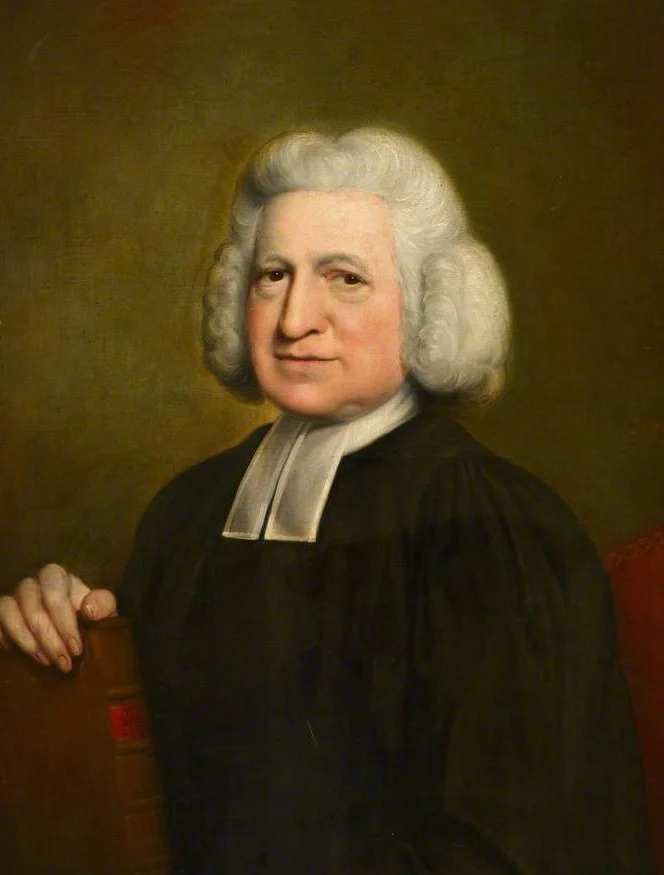
Public domain
Charles Wesley
1707 – 1788
Also known as: Sweet Singer of Methodism
Methodist — Hymnody
Charles Wesley was born on December 18, 1707, in Epworth, Lincolnshire, the eighteenth child of Samuel and Susanna Wesley. His father was the rector of Epworth. A seven months' child, he was reared with difficulty. He followed his brother Samuel to Westminster School, where he was elected king's scholar in 1721, and then to Christ Church, Oxford, where he graduated B.A. in 1730 and M.A. in 1733. In the spring of 1729, by his own account, he persuaded "two or three young scholars" to keep the method of study the university prescribed, which "gained me the harmless nickname of methodist." When John returned to Oxford that November he took the lead of the little society, later called the Holy Club.
In 1735 Charles accompanied John to the Georgia colony as secretary to Governor James Oglethorpe, but the mission proved disastrous. His strictness made him enemies at Frederica, he fell ill, and he left Savannah in July 1736, landing in England that December. The real turning point came on May 21, 1738, three days before his brother's famous Aldersgate experience. Ill with pleurisy, he had read Luther on Galatians on 17 May and found it "nobly full of faith." On Whitsunday he wrote in his journal: "I now found myself at peace with God, and rejoiced in hope of loving Christ." Two days later he began "an hymn upon my conversion," broke off for fear of pride, and finished it.
For the next fifty years Charles worked beside John in the Methodist revival; their differences never broke their confidence in each other. He rode the itinerant circuits from 1739 until November 1756, from the keelmen of Newcastle to the tinners of Cornwall, and twice crossed to Ireland. He held fast to the Church of England, resisted every move toward separation, and was vehemently opposed to the ordinations his brother began in 1784. On 8 April 1749 he married Sarah Gwynne of Garth, nineteen years his junior; they lived at Bristol and, from 1771, in London. They had eight children, three of whom survived to adulthood.
His Writing and Influence
He is said to have written some 6,500 hymns. From 1739 to 1746 the brothers issued eight collections in their joint names, beginning with Hymns and Sacred Poems (1739), and more than thirty followed under Charles's name alone, from Hymns on God's Everlasting Love (1741) to Hymns for the Nation (1782). John edited his brother's hymns for public use, so their work cannot always be told apart. The hymns served as theology in verse, taught and remembered by singing. "And Can It Be That I Should Gain," "Christ the Lord Is Risen Today," "Hark! The Herald Angels Sing," and "Love Divine, All Loves Excelling" are among those still sung.
His hymns treat every subject from the side of spiritual experience, and many were written for particular occasions: the great festivals, the Lord's Supper, times of persecution, an earthquake, a threatened invasion, the deathbed. His Hymns on the Lord's Supper (1745) expressly teach the real presence. The translations from German in the joint collections are usually given to John, since Charles seems not to have read the language.
Charles Wesley died in London on 29 March 1788 and was buried, at his own wish, in the churchyard of St Marylebone. His hymns outlived the controversies of his time and are sung across the churches; about five hundred were in constant use at the end of the nineteenth century.
Works by Charles Wesley
Begin with A Collection of Hymns for the Use of the People Called Methodists (1780), the hymn book his brother arranged from his hymns, then Hymns on the Lord's Supper. The Journal of the Rev. Charles Wesley tells of his conversion in 1738 and the years on the road that followed.
- Hymns and Sacred Poems 1739 – 1749
- Funeral Hymns 1746 – 1759
- Sermons 1816
Influence
Who shaped Charles Wesley, and who Charles Wesley shaped, and who worked beside Charles Wesley. Each line is drawn from the research behind the catalogue; the evidence sits in the catalogue, not on this page.
Influenced by
- Martin Luther 1483–1546 through Commentary on Galatians
Influenced
- George Whitefield 1714–1770 through Short Account of God's Dealings with the Reverend Mr. George Whitefield
Worked with
- John Wesley 1703–1791
Resources
Catalog IDA.FMH9RN.4