

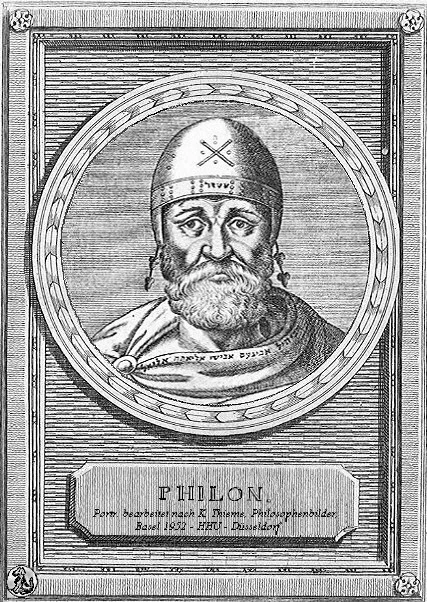
Public domain
Philo of Alexandria
20 BCE – 50
Also known as: Philo Judaeus, Philon of Alexandria, Philo the Jew, Philon ho Alexandreus
Hellenistic Judaism — Philosophy
Philo of Alexandria (20 BC–AD 50)
Philo was born in Alexandria around 20 BC, a decade or so after Rome absorbed Egypt following the death of Cleopatra. He is known in Greek as Philōn and in Latin as Philo Judaeus, "Philo the Jew," a name that says what his life was about. He belonged to one of the wealthiest and most politically connected Jewish families in the Mediterranean world. His brother Gaius Julius Alexander held the office of alabarch, with responsibility for customs on the Arabian frontier, and managed the Egyptian estates of Antonia, the emperor Claudius's mother. Josephus records that this brother also covered the Temple in Jerusalem's gates with gold and silver plating. Philo's nephew Tiberius Julius Alexander rose higher still, becoming Roman prefect of Egypt and later a senior officer in the army that besieged Jerusalem in AD 70. He had abandoned the ancestral faith to do so. Philo's family was Jewish, rich, and deeply entangled with Roman power, and the tensions of that position run through his life.
Alexandria shaped him in every way. It was a Greek city with a vast Jewish population, home to the Museum and the great Library, and it was where the Hebrew Scriptures had been translated into Greek. Philo's education was the standard Greek curriculum of his class: grammar, rhetoric, geometry, music, and philosophy. He absorbed Plato through the Middle Platonist tradition, along with Stoic and Pythagorean elements. Yet his deepest text was the Greek Pentateuch, which he read in the Septuagint, and scholars still debate how much Hebrew he knew. He had no ecclesiastical office and no rabbinic ordination. He was a lay Jew of the diaspora who read Moses as a philosopher and read philosophy as Moses' pupil. He once traveled to Jerusalem to pray and offer sacrifice, a pilgrimage he mentions in passing.
He was drawn to contemplation, and he knew the cost of being pulled away from it. In a passage in On the Special Laws, he writes of the happiness of a life spent among books and the study of the cosmos, and of how the "sea of civil cares" swept him from that life into public affairs. In another place he describes moments of inner dryness followed by sudden fullness, when thoughts poured into him as if he were seized by a divine frenzy. Both of these were real parts of his life: the quiet study and the public duty that kept interrupting it.
The public duty became a crisis in AD 38. Under the prefect Flaccus, and with the emperor Gaius Caligula newly enthroned, anti-Jewish violence broke out in Alexandria. Synagogues were desecrated, images of the emperor were forced into them, Jews were herded into a single quarter of the city, and many were beaten, killed, or stripped of their property. Philo described these events afterward in Against Flaccus. In the winter of AD 39–40 the Alexandrian Jewish community sent a delegation to Rome to appeal to Caligula, and Philo, by then an old man by his own account, led it. The audience was a humiliation. The emperor, who demanded to be honored as a god and was preparing to set up his statue in the Jerusalem Temple, mocked the delegates and asked why they would not eat pork. Philo's On the Embassy to Gaius records that he comforted his companions with the thought that God would fight for them. Caligula's assassination in AD 41 ended the immediate threat, though the underlying conflict in Alexandria did not end.
Nothing reliable survives about Philo's final years. The traditional date of his death, around AD 50, rests on the last datable events in his writings. Later Christian legend tied him to Peter in Rome, but there is no evidence for it. What the record does show is a man who spent his life holding together things that his world pulled apart: Athens and Jerusalem, wealth and devotion, philosophy and Scripture, a persecuted people and the empire that ruled them.
His Writing and Its Influence
Philo's surviving work is large, and nearly all of it is commentary on the Greek Pentateuch. It falls into rough groups. The Allegorical Commentary, which includes Allegorical Interpretation, On the Unchangeableness of God, and On the Migration of Abraham, follows Genesis verse by verse and reads each figure as a stage in the soul's journey. The Exposition of the Law, which opens with On the Creation of the World and includes On the Life of Moses, On the Decalogue, and On the Special Laws, presents Mosaic teaching to a wider, partly non-Jewish audience. Questions and Answers on Genesis and Exodus survives largely in an Armenian translation. The historical works, Against Flaccus and On the Embassy to Gaius, are his reports on the persecution. His account of an ascetic community near Alexandria in On the Contemplative Life is the only surviving description of the Therapeutae.
His method was allegory, which he took from Alexandrian readers of Homer and the Stoics and turned to the Torah. The literal text, he held, was the body and the hidden meaning was the soul. He did not abandon the body. He rebuked fellow allegorists who treated the commandments as symbols and stopped observing them. His God is transcendent and finally unknowable in essence, and he stands between the biblical Creator and the Platonic One. To bridge the distance he made the Logos, the divine Word or Reason, the intermediary through which God orders the world and meets the soul. Whether the Logos is a person or a personification remains disputed, and Philo never settled it. The result is not a system. His treatises wander, repeat themselves, and sometimes contradict one another, and the allegories can look arbitrary.
His fate in transmission is unusual. Rabbinic tradition never mentions him, and his Greek-speaking, Platonizing Judaism had little future inside the Jewish world until the sixteenth century, when Azariah de' Rossi brought him back into Jewish discussion. Christians preserved him. Clement of Alexandria quoted him freely, Origen studied him closely, and a copy of his works was kept in the library at Caesarea, from which later copying descended. Eusebius and Jerome both noted him. Ambrose borrowed from him heavily, and Gregory of Nyssa's Life of Moses belongs to the tradition he began, in which Moses climbs toward a God who grows more hidden as he is approached. Without these Christian readers much of Philo would be lost. Christians also claimed him on thin evidence. Eusebius thought the Therapeutae were Christians, and the legend of a meeting with Peter grew from that kind of wishful reading.
Scholars still argue about his relation to the New Testament. Parallels with the Prologue of John and with Hebrews are real, but most now see a shared Hellenistic Jewish background and not direct dependence. Modern assessments have swung. Early twentieth-century critics sometimes treated him as a Greek philosopher in Jewish dress. Erwin Goodenough saw a Jewish mystery religion, and Harry Wolfson made him the founder of religious philosophy in the West. More recent work, much of it published in Studia Philonica and associated with David Runia, reads him as a Jewish exegete whose philosophical tools served his reading of Scripture. Reformation and Antiochene suspicion of allegory also colored Christian opinion of him for long stretches.
Influence
Who shaped Philo of Alexandria, and who Philo of Alexandria shaped. Each line is drawn from the research behind the catalogue; the evidence sits in the catalogue, not on this page.
Influenced by
- Plato 427 BCE–347 BCE
Influenced
- Clement of Alexandria 150–215 through The Stromata
- Origen of Alexandria 185–253 through Against Celsus
- Eusebius of Caesarea 260–340 through Ecclesiastical History
- Didymus the Blind 313–398 through Commentary on Genesis
- Gregory of Nyssa 335–395 through Life of Moses
- Ambrose of Milan 340–397 through On Cain and Abel
- Jerome 347–420 through On Illustrious Men
- Augustine of Hippo 354–430 through Against Faustus the Manichean
- Jean Daniélou 1905–1974
Resources
- Stanford Encyclopedia of Philosophy: Philo of Alexandria Academic
- Internet Encyclopedia of Philosophy: Philo of Alexandria (Marian Hillar) Academic
- Catholic Encyclopedia (1911): Philo Judaeus Biography
- Jewish Encyclopedia (1906): Philo Judaeus Biography
- CCEL: The Works of Philo Judaeus, tr. C. D. Yonge (Bohn, 1854-55) Primary source
- Early Christian Writings: The Works of Philo, tr. C. D. Yonge Primary source
Catalog IDA.DVCS2H.Y