

In copyright
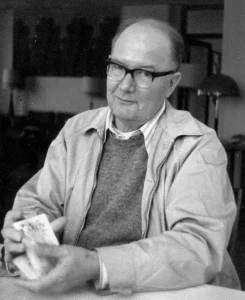
Bernard Lonergan
1904 – 1984
Also known as: Bernard Joseph Francis Lonergan
Catholic — Theology, Philosophy
Bernard Joseph Francis Lonergan was born on December 17, 1904, in Buckingham, Quebec, the eldest of three sons in a family of Irish Catholic heritage. His father Gerald worked as a surveyor and engineer; his mother Josephine was a school teacher before marriage. The family moved to Montreal when Bernard was young, and he attended Loyola College, a Jesuit institution, where he excelled academically and showed early signs of the intellectual rigor that would mark his career. In 1922, at eighteen, he entered the Jesuit novitiate at Guelph, Ontario, beginning a formation that would span fourteen years and take him from Canada to England.
Lonergan's Jesuit training followed the traditional pattern: two years of novitiate, three years studying classics and mathematics at Heythrop College in Oxfordshire, then three years teaching at Loyola College Montreal before beginning theological studies at Heythrop in 1930. He was ordained priest in 1936. The depth of his philosophical formation during these years cannot be overstated — he worked through Aristotle, Aquinas, and the entire scholastic tradition with a thoroughness that few of his generation matched. But Lonergan was not content to receive this tradition passively. Even in his student years, he was asking fundamental questions about knowledge, understanding, and method that would eventually revolutionize Catholic theology.
After completing a doctorate in theology at the Gregorian University in Rome, writing on the concept of operative grace in Aquinas, Lonergan returned to teaching, first at the Seminary of Christ the King in London, Ontario, then at Regis College, the Jesuit theologate in Toronto. It was during these years in Canada, from 1947 to 1965, that he produced his most significant work. The intellectual isolation of wartime and post-war Canada proved oddly conducive to original thinking. Lonergan spent these decades in what he described as reaching up to the mind of Aquinas — not simply studying Thomas's conclusions, but retracing and extending the fundamental insights about human knowing that underlay the entire scholastic enterprise.
His Writing and Its Influence
Lonergan began publishing scholarly articles in the 1940s, but his major contribution emerged in 1957 with Insight: A Study of Human Understanding, a dense 750-page investigation of what happens when we know anything at all. The book argued that genuine objectivity comes not from taking a supposedly neutral look at reality, but from the rigorous unfolding of our own conscious and intentional operations — experiencing, understanding, judging, and deciding. This was not psychology but what Lonergan called "cognitional theory," a precise mapping of the invariant structure of human knowing that could ground both science and theology on firmer foundations.
Method in Theology, published in 1972 after Lonergan had moved to Harvard Divinity School, applied these insights to theological work itself. Lonergan argued that theology's crisis was methodological — theologians had been trying to do their work without first understanding what they were doing when they did it. The book proposed eight functional specialties that would organize theological collaboration and bring theology into critical dialogue with modern scholarship. Both works were notoriously difficult, requiring readers to perform for themselves the acts of understanding that Lonergan was describing rather than simply learning conclusions.
The reception was mixed and often delayed. Progressive Catholics sometimes found Lonergan too scholastic; traditional Catholics found him too innovative. But gradually, particularly in North American Catholic universities, Lonergan centers and doctoral programs emerged. His influence extended beyond Catholic circles to philosophers, economists, and methodologists in various fields. The Lonergan Institute at Boston College continues to publish his collected works and sponsor research. His fundamental insight — that we cannot understand anything properly until we understand our own understanding — remains as challenging now as when he first articulated it.
Lonergan suffered from cancer in his later years and died on November 26, 1984, in Pickering, Ontario. His tombstone bears a phrase from his writing: "What is good, always better."
Works by Bernard Lonergan
Begin with Understanding and Being, the 1958 Halifax lectures in which Lonergan introduced Insight to a general audience. Then read Insight itself, slowly, and after it Method in Theology; the three Collections and Verbum come after those.
- Insight 1957
- The Incarnate Word 1960
- The Triune God 1964
- Collection 1967
- The Subject 1968
- Doctrinal Pluralism 1971
- Grace and Freedom 1971
- Method in Theology 1972
- A Second Collection 1974
- A Third Collection 1985
- Topics in Education 1993
- Shorter Papers 2007
- Early Latin Theology 2011
- The Redemption 2018
Influence
Who shaped Bernard Lonergan, and who Bernard Lonergan shaped. Each line is drawn from the research behind the catalogue; the evidence sits in the catalogue, not on this page.
Influenced by
- Augustine of Hippo 354–430
- Thomas Aquinas 1225–1274 through Verbum: Word and Idea in Aquinas
- John Henry Newman 1801–1890
Influenced
- N. T. Wright 1948–?
Resources
- Bernard Lonergan Archive Primary source
- Lonergan Resource Academic
Catalog IDA.8DYF6M.E