

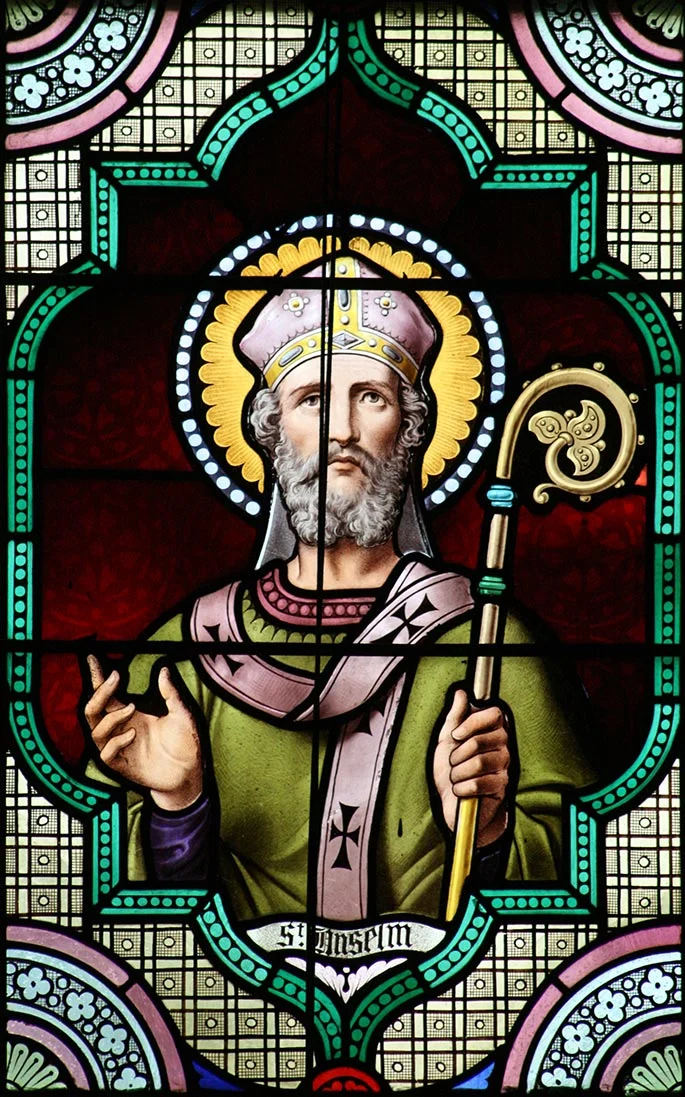
Public domain
Anselm of Canterbury
1033 – 1109
Also known as: Saint Anselm, Anselmus Cantuariensis, Anselm of Aosta, Anselm of Bec, Anselm
Medieval — Philosophy/Theology
Anselm was born around 1033 in Aosta, a town in the Alpine passes between Italy and France, to a Lombard noble family. His father Gundulf was worldly and harsh; his mother Ermenberga was devout. The tension between them would shape Anselm's early years and his eventual flight from home. As a young man he felt called to monastic life, but his father's opposition was fierce. When Ermenberga died, Anselm's interest in learning waned, and family conflicts intensified. At twenty-three he left Aosta, wandering through Burgundy and France for three years before arriving at the Norman abbey of Bec in 1059.
At Bec he found what he had been seeking. The abbey was led by Lanfranc, already renowned as one of Europe's foremost scholars and dialecticians. Under Lanfranc's guidance Anselm discovered that rigorous intellectual work could serve contemplative devotion rather than competing with it. When Lanfranc departed for Caen in 1063, Anselm was chosen as prior. He proved a gifted teacher and spiritual director, attracting students from across Europe. In 1078 he became abbot, a position he held for fifteen years. These were his most creative years intellectually. The monastic rhythm of prayer, study, and teaching provided the matrix within which his theological method matured.
In 1093 Anselm was appointed Archbishop of Canterbury, succeeding Lanfranc. He accepted reluctantly, and his instincts proved sound. The position embroiled him in conflicts with two successive kings — William Rufus and Henry I — over ecclesiastical independence and reform. Both kings sought to control church appointments and revenues; Anselm insisted on the church's freedom to govern itself according to canon law. The disputes forced him into exile twice, first from 1097 to 1100, then from 1103 to 1106. He spent these years in Rome and at various monasteries, continuing his theological writing. The conflicts were resolved only partially before his death in 1109, but Anselm's principled resistance helped establish precedents for ecclesiastical independence that would influence church-state relations for centuries.
His Theological Method and Influence
Anselm began writing during his years as prior at Bec, producing works that transformed medieval theology by demonstrating how philosophical reasoning could illuminate Christian doctrine. His Monologion, completed around 1076, offered rational arguments for God's existence and attributes. The Proslogion, finished two years later, presented his famous ontological argument — the demonstration that God's existence follows necessarily from the concept of God as "that than which nothing greater can be conceived." Both works emerged from his teaching and from questions posed by his fellow monks. Anselm's method was to pursue rational inquiry within the bounds of faith, captured in his formula "faith seeking understanding."
His Cur Deus Homo, written during his first exile, addressed the question of why God became incarnate. Against contemporary theories that portrayed the atonement as a transaction with the devil, Anselm argued that Christ's death satisfied the honor of God violated by human sin. The work's legal precision and logical structure made it enormously influential in Western atonement theology. His other writings included treatises on free will, the Trinity, and the virginal conception of Christ, along with a substantial collection of letters and prayers that reveal the devotional heart beneath the rigorous intellect.
Anselm's integration of reason and faith established him as the father of scholastic theology, influencing Thomas Aquinas and the entire medieval synthesis. His ontological argument has been debated by philosophers from Aquinas to Kant to contemporary thinkers. But for Anselm the intellectual work was always in service of worship and spiritual understanding. His prayers, written for his students, demonstrate the same precision applied to the language of devotion. He died at Canterbury on April 21, 1109, and was canonized in 1494.
Works by Anselm of Canterbury
Begin with the Proslogion: short, written as a prayer, and the source of the argument that 'that than which nothing greater can be thought' must exist. Read Gaunilo's objection and Anselm's Reply with it. Then Cur Deus Homo, on why God became man. The Monologion and the three dialogues (On Truth, On Freedom of Choice, On the Fall of the Devil) follow for readers who want his whole system.
- Letters 1070 – 1109
- Prayers and Meditations 1070 – 1080
- Reply to Gaunilo 1078 – 1079
- On the Grammarian 1080 – 1085
- On Free Will 1080
- On Truth 1080
- Why God Became Man 1094 – 1098
- On the Sacraments of the Church 1106 – 1107
Doubtful and spurious works
Works that have circulated under Anselm of Canterbury’s name. Disputed: scholars question whether Anselm of Canterbury wrote it. Spurious: judged not to be by Anselm of Canterbury.
Homilies and short exhortations printed under Anselm's name; Gerberon traces one homily to manuscripts that name him and says the exhortations were first published by Théophile Raynaud on grounds he does not know.
A monastic poem printed among Anselm's works; Gerberon notes that a Bec manuscript ascribes it to Roger of Caen, a monk of Bec, and declines to decide.
- On the Will Disputed
A short tract Gerberon printed from a Saint-Victor manuscript, guessing Anselm wrote it shortly before he died to keep a promise in De Concordia; it is not among the treatises of the modern editions.
- Sayings of Anselm Disputed
Sayings of Anselm written down by others, as the titles say ('useful sayings taken from the sayings of St Anselm'); his teaching in his hearers' words.
- On Peace and Concord Spurious
Author unknown.
Ascribed to Anselm in one Louvain manuscript; Gerberon, who printed it, judged that it is foreign to Anselm's style and thought.
About & Related Works
Works about Anselm of Canterbury, plus compilations, editions and commentary — offered as resources, not as their own writing.
Influence
Who shaped Anselm of Canterbury, and who Anselm of Canterbury shaped. Each line is drawn from the research behind the catalogue; the evidence sits in the catalogue, not on this page.
Influenced by
- Augustine of Hippo 354–430 through Monologion
- Lanfranc of Bec 1005–1089 was taught by
- Gaunilo of Marmoutiers responded to
Influenced
- Eadmer 1060–1124 taught
- Thomas Aquinas 1225–1274 was answered by through Proslogion
- Karl Barth 1886–1968 through Proslogion
- Marilyn McCord Adams 1943–2017
Resources
- Catholic Encyclopedia (1913): St. Anselm Biography
- Stanford Encyclopedia of Philosophy: Saint Anselm Academic
- Internet Encyclopedia of Philosophy: Anselm of Canterbury Academic
- CCEL: Anselm of Canterbury Primary source
- Jasper Hopkins: Anselm in English (archived site) Primary source
Catalog IDA.F4ZB38.9