

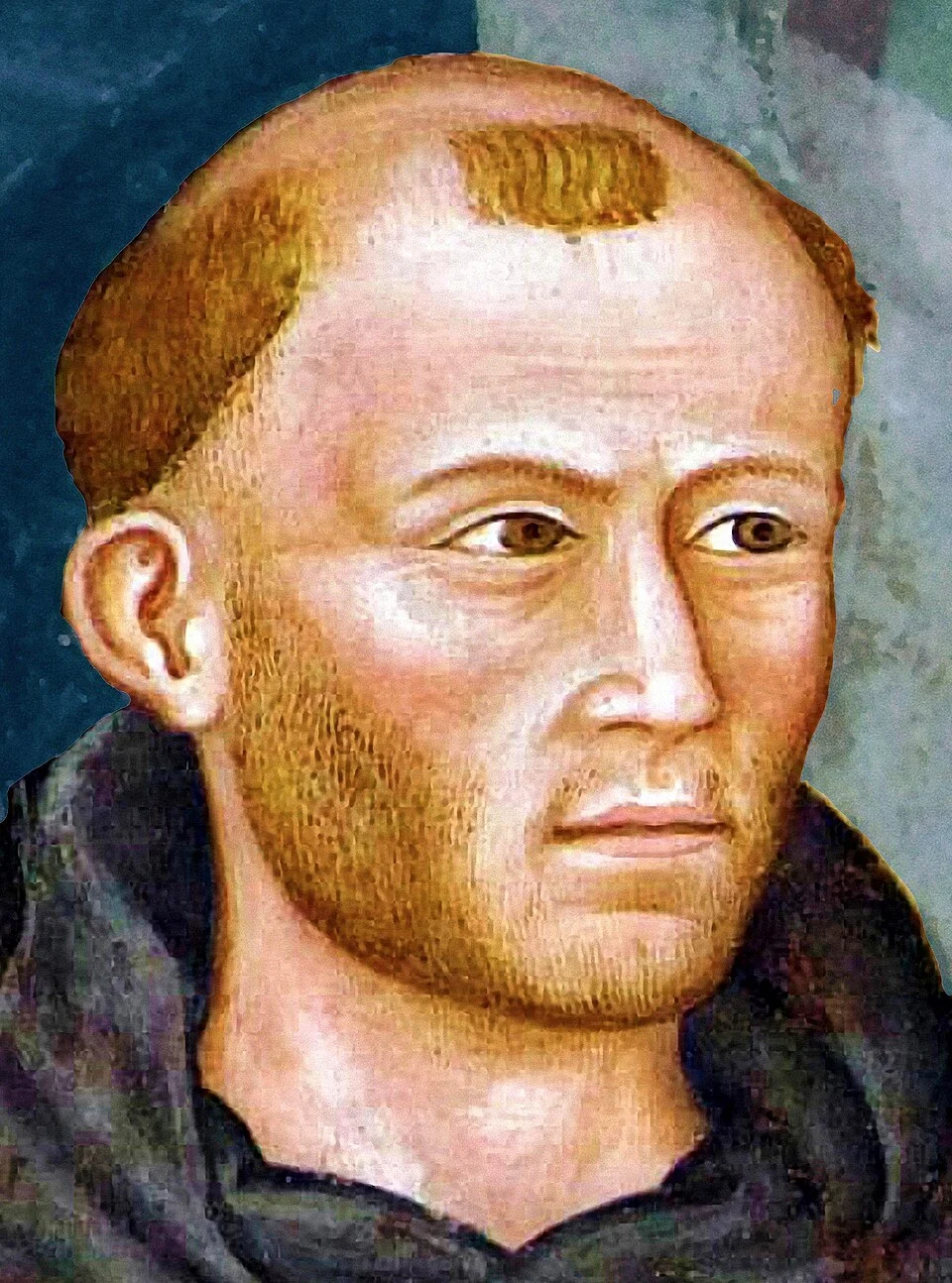
Public domain
Meister Eckhart
1260 – 1328
Also known as: Eckhart von Hochheim, Johannes Eckhart, Johann Eckhart, Master Eckhart
Medieval — Mysticism/Philosophy
Eckhart von Hochheim was born around 1260 in Thuringia, in what is now central Germany. The place is not certain: older accounts name Hochheim, and recent scholars think it was probably Tambach, near Erfurt. He entered the Dominican order as a young man, most likely at Erfurt. The Dominicans were the order of preachers and scholars of his age, and he served it as both.
He studied and taught at Paris, the theological centre of Europe. In 1293–94 he lectured there on the Sentences of Peter Lombard, and on 18 April 1294 he preached the Easter sermon at the Dominican church of Saint-Jacques. Late in 1294 he returned to Erfurt as prior of the convent and vicar of Thuringia. In 1302 he became master of theology at Paris, the title "Meister" by which he is known. In 1303 he was made the first provincial of the new Dominican province of Saxony, which he governed until 1311, and in 1307 he was also named vicar-general for Bohemia. In 1311 the order sent him back to Paris to teach a second time.
In 1313 he went to Strasbourg as a special vicar of the Master of the Order, with the care of convents of Dominican nuns and of houses of beguines, and around 1323 he moved to the Dominican house at Cologne, where Johannes Tauler and Henry Suso came to know him. He preached in Latin to friars and clerics and in Middle High German to lay hearers and to communities of religious women, and many of his German sermons were given at Strasbourg. In them he spoke of the birth of the eternal Word in the ground of the soul, and of the soul's union with God, in terms that some hearers took to erase the distinction between creature and Creator.
In 1326 Archbishop Henry of Virneburg of Cologne had a commission examine lists of articles drawn from his writings and sermons. On 26 September 1326 Eckhart answered forty-nine of them, protesting that he had never been suspected of heresy and declaring himself ready to retract any error that was shown. In 1327 he appealed to the pope and went to Avignon. He died before 30 April 1328, probably on 28 January 1328, possibly at Avignon, before the case was decided.
His Writing and Theological Legacy
On 27 March 1329 Pope John XXII issued the bull "In agro dominico," which condemned twenty-eight articles: seventeen as heretical, and eleven as evil-sounding, rash and suspect of heresy. Among them was the claim that there is something in the soul that is uncreated and cannot be created. The bull also records that at the end of his life Eckhart professed the Catholic faith and revoked the twenty-six articles he admitted preaching, together with anything else he had written or taught, insofar as it could produce a heretical or erroneous sense in the minds of the faithful.
Eckhart's writing falls into two parts. In Latin he planned the Opus tripartitum, a work in three parts of propositions, questions and expositions; what survives is its prologues, commentaries on Genesis, Exodus, Wisdom and the Gospel of John, sermons and lectures on Ecclesiasticus 24, and a collection of Latin sermons, together with the Parisian Questions and the defence he wrote in 1326. In German he left sermons and four treatises: the Talks of Instruction, given while he was prior of Erfurt; the Book of Divine Consolation and On the Nobleman, which together made the book he sent to the Queen of Hungary; and On Detachment. In the German works he teaches detachment (abegescheidenheit) and the letting-go of self-will (gelâzenheit): the soul must become empty of attachment to created things to make room for God. He speaks of the "birth of God in the soul," and his language for that union is direct: "The eye wherein I see God is the same eye wherein God sees me; my eye and God's eye are one eye, one vision, one knowing, one love."
His German theology influenced Johannes Tauler and Henry Suso, both Dominicans, and Suso, who had been his student, praised him in his Horologium Sapientiae. Nicholas of Cusa had his Latin works copied in 1444 and annotated them in his own hand. In the modern period Hegel and Heidegger drew on him. In 2012 the Master of the Dominican Order wrote that a commission set up by the order's General Chapter of 1980 had shown that the bull condemned certain of his formulations, not his doctrine, and not the man himself.
Works by Meister Eckhart
Begin with the Talks of Instruction, the short talks Eckhart gave as prior of Erfurt on obedience, self-will and having God in ordinary work. Then read The Book of Divine Consolation and On the Nobleman, the two parts of the book he sent to the Queen of Hungary, and On Detachment, before The German Sermons. The Latin works, beginning with the prologues of the Opus tripartitum and the Commentary on the Gospel of John, assume a reader at home in scholastic theology.
- Talks of Instruction 1294 – 1298
- Latin Sermons 1294 – 1327
- The German Sermons 1300 – 1327
- Sermons and Treatises 1300 – 1328
- Parisian Questions 1302 – 1303
- The Book of Divine Consolation 1314 – 1318
- Commentary on the Gospel of John 1314 – 1323
- On Detachment 1314 – 1320
- Defense 1326
Influence
Who shaped Meister Eckhart, and who Meister Eckhart shaped. Each line is drawn from the research behind the catalogue; the evidence sits in the catalogue, not on this page.
Influenced by
- Augustine of Hippo 354–430 through Commentary on Genesis
- Boethius 480–524 through On Detachment
- Pseudo-Dionysius the Areopagite 490–520 through On Detachment
- Albert the Great 1200–1280
- Thomas Aquinas 1225–1274 through The Threefold Work
Influenced
- Heinrich Suso 1295–1366 taught
- Johannes Tauler 1300–1361
- Nicholas of Cusa 1401–1464 through Commentary on the Gospel of John
- Thomas R. Kelly 1893–1941
Appears in these collections
- Mystical Witness Witnesses to prayer, divine love, and transformation across the Christian centuries. (listed as an author)
Resources
Catalog IDA.A0SNWN.J