

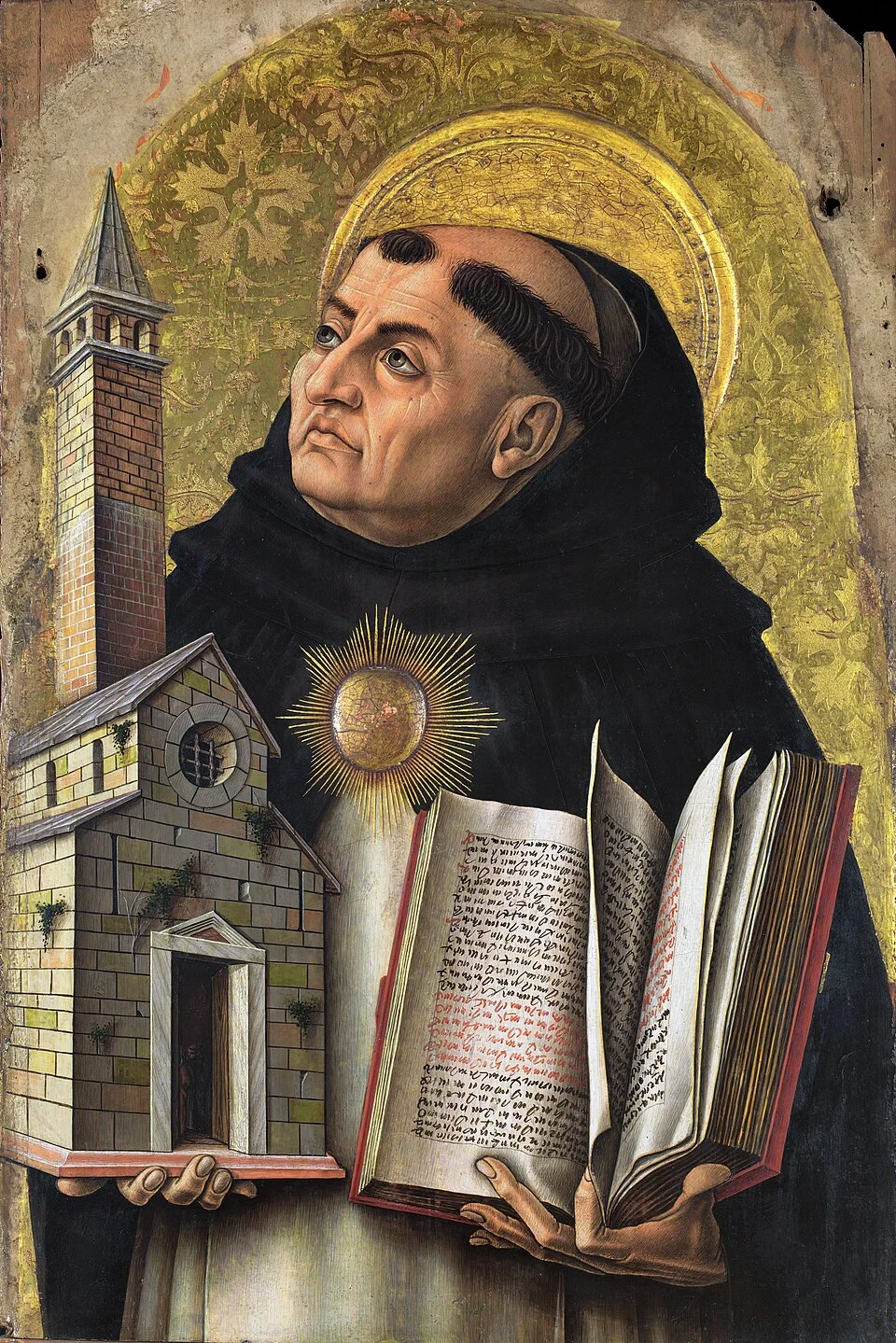
Public domain
Thomas Aquinas
1225 – 1274
Also known as: Saint Thomas Aquinas, Doctor Angelicus, Thomas of Aquino, Sanctus Thomas de Aquino, The Angelic Doctor, The Universal Doctor
Scholastic — Theology/Philosophy
Thomas Aquinas was born around 1225 at Roccasecca, near Aquino in southern Italy, the youngest son of Count Landulf of Aquino. His family held considerable political influence in the region, with connections to both the Holy Roman Emperor and the Pope. At age five he was sent to the Benedictine monastery of Monte Cassino for his early education, where his uncle served as abbot. The family likely intended him for an ecclesiastical career that would advance their political interests.
Around 1239 Thomas was sent to the University of Naples, recently founded by Emperor Frederick II. There he encountered the works of Aristotle and came into contact with the Dominican friars. Against fierce family opposition, he joined the Dominican order in 1244 at age nineteen. His family was so outraged by this decision — the Dominicans were a mendicant order that embraced poverty, unlike the wealthy Benedictines — that his brothers kidnapped him and held him prisoner for nearly two years at the family castle, attempting to break his resolve. They even sent a prostitute to his room to seduce him away from his vocation. Thomas reportedly drove her away with a burning brand from the fireplace.
Released in 1245, Thomas went to Paris to study under Albert the Great, the most prominent Dominican intellectual of his time. He followed Albert to Cologne in 1248, where he began his teaching career. His fellow students initially called him "the dumb ox" because of his quiet demeanor and large frame, but Albert famously predicted that "this ox will fill the world with his bellowing." Thomas returned to Paris in 1252 to complete his theological doctorate, becoming a master in 1256 despite significant opposition from secular clergy who resented the mendicant orders' growing influence in the universities.
Thomas spent his career moving between Paris, Italy, and various Dominican houses, always writing. He taught at the papal court, advised popes, and was called upon to settle theological disputes. He established Dominican schools of theology in Rome and Naples. His method was revolutionary: while most theologians remained suspicious of pagan philosophy, Thomas systematically integrated Aristotelian thought with Christian doctrine, arguing that reason and faith were complementary paths to truth. This synthesis was controversial and faced considerable resistance during his lifetime.
He died on March 7, 1274, at the Cistercian monastery of Fossanova while traveling to the Council of Lyon. He was forty-eight. Some of his propositions were condemned by the Bishop of Paris in 1277, three years after his death, but he was canonized in 1323 and declared a Doctor of the Church in 1567.
His Writing and Its Influence
Thomas began writing in earnest during his first period as a master in Paris in the 1250s. His earliest major work was a commentary on Peter Lombard's Sentences, the standard theological textbook of the medieval universities. But his distinctive voice emerged in his systematic integration of Aristotelian philosophy with Christian theology, most fully realized in his two great syntheses: the Summa contra Gentiles (completed around 1264) and the Summa Theologica (begun around 1265 and left unfinished at his death).
The Summa Theologica was designed as a textbook for students beginning theology, though its scope and depth far exceeded any introductory text before or since. Written in the form of questions and articles, it addresses virtually every aspect of Christian doctrine through rigorous logical analysis. Thomas's method was to state a question, present objections, cite contrary authorities, and then provide his own reasoned solution. The work demonstrates an extraordinary mastery of Scripture, the Church Fathers, canon law, and both Christian and non-Christian philosophy.
Thomas wrote prolifically — biblical commentaries, disputed questions, treatises on specific topics, hymns for the feast of Corpus Christi. His complete works fill more than forty volumes. But it was the Summa Theologica that became the foundation of Catholic theological education for centuries. The Council of Trent drew heavily upon his work, and in 1879 Pope Leo XIII's encyclical Aeterni Patris officially endorsed Thomistic philosophy as the basis for Catholic intellectual life.
His influence extends far beyond Catholicism. Protestant Reformers, while rejecting his synthesis of reason and revelation, engaged seriously with his arguments. Modern philosophers from diverse traditions continue to wrestle with his contributions to metaphysics, ethics, and political theory. Contemporary evangelical theologians have increasingly recognized the value of his theological method and his treatment of classical Christian doctrines.
Works by Thomas Aquinas
Begin with the Exposition of the Apostles' Creed and the Exposition of the Lord's Prayer, plain sermons that give his whole faith in brief. Then the Summa Theologiae, an article at a time: the first questions of the First Part, on God, and the questions on law in the First Part of the Second. The Compendium of Theology is the short version, the Summa contra Gentiles the long argument; the Commentary on the Gospel of John and the Commentary on the Letters of St Paul show him reading Scripture.
- Literal Exposition on Isaiah 1251 – 1252
- Exposition on Jeremiah 1251 – 1253
- Commentary on the Sentences 1252 – 1256
- Commentary on Boethius's De Hebdomadibus 1256 – 1259
- Quodlibetal Questions 1256 – 1272
- Disputed Questions on Truth 1256 – 1259
- Sermons 1256 – 1273
- Commentary on Boethius's On the Trinity 1257 – 1259
- On the Reasons for the Faith 1259 – 1265
- Summa Against the Gentiles 1259 – 1265
- Against the Errors of the Greeks 1263 – 1264
- Literal Exposition on Job 1263 – 1265
- Commentary on the Letters of St Paul 1263 – 1273
- On Power 1265 – 1267
- On Kingship 1265 – 1267
- Summa of Theology 1265 – 1273
- Disputed Questions on the Soul 1266 – 1267
- Disputed Question on Spiritual Creatures 1267 – 1268
- Commentary on Aristotle's On the Soul 1267 – 1268
- Exposition of the Apostles' Creed 1268 – 1273
- Commentary on Aristotle's Physics 1268 – 1270
- Compendium of Theology 1269 – 1273
- On Lots 1269 – 1271
- Disputed Questions on Evil 1269 – 1271
- Commentary on the Gospel of Matthew 1269 – 1270
- Commentary on Aristotle's Metaphysics 1270 – 1273
- Commentary on the Gospel of John 1270 – 1272
- On Separate Substances 1271 – 1273
- Disputed Questions on the Virtues 1271 – 1272
- Exposition on the Psalms 1272 – 1273
- Commentary on the Book of Causes 1272 – 1273
Disputed works
Works that have circulated under Thomas Aquinas’s name. Disputed: scholars question whether Thomas Aquinas wrote it.
Corpus Thomisticum's page heads it as of probable authenticity; it is not in the earliest lists of his works.
Corpus Thomisticum puts it among the works of probable authenticity ('Opera probabilia authenticitate'), not the certain ones.
- On the Book of Life Disputed
Corpus Thomisticum puts it among the works of probable authenticity.
Influence
Who shaped Thomas Aquinas, and who Thomas Aquinas shaped. Each line is drawn from the research behind the catalogue; the evidence sits in the catalogue, not on this page.
Influenced by
- Aristotle 384 BCE–322 BCE through Commentary on Aristotle's Metaphysics
- John Chrysostom 349–407 through Homilies on the Gospel of Matthew
- Augustine of Hippo 354–430 through On the Trinity
- John Cassian 360–435 through The Institutes
- Leo the Great 400–461 through Tome to Flavian
- Boethius 480–524
- Pseudo-Dionysius the Areopagite 490–520
- Gregory the Great 540–604 through Homilies on the Gospels
- John of Damascus 675–749 through Summa of Theology
- Anselm of Canterbury 1033–1109 responded to through Proslogion
- Peter Lombard 1100–1160 through Commentary on the Sentences
- Albert the Great 1200–1280 was influenced by was taught by
Influenced
- Meister Eckhart 1260–1328 through The Threefold Work
- Dante Alighieri 1265–1321
- Jan Hus 1372–1415 through Commentary on the Four Books of Sentences
- John of the Cross 1542–1591 through The Ascent of Mount Carmel
- G. K. Chesterton 1874–1936
- Étienne Gilson 1884–1978
- Edith Stein 1891–1942 through Finite and Eternal Being
- Henri de Lubac 1896–1991 through The Mystery of the Supernatural
- Bernard Lonergan 1904–1984 through Verbum: Word and Idea in Aquinas
- Josef Pieper 1904–1997 through Guide to Thomas Aquinas
- Yves Congar 1904–1995
- Francis Schaeffer 1912–1984 was answered by through Escape from Reason
- John Paul II 1920–2005 through Faith and Reason
- Alvin Plantinga 1932–? through Warranted Christian Belief
- Peter Kreeft 1937–?
- Robert Barron 1959–? through Thomas Aquinas: Spiritual Master
Resources
- Catholic Encyclopedia (1912): St. Thomas Aquinas Biography
- Stanford Encyclopedia of Philosophy: Thomas Aquinas Organization
- Corpus Thomisticum: the Latin works (Opera omnia) Primary source
- Joseph Kenny's Thomas Aquinas collection: works in English and Latin Primary source
Catalog IDA.GGE466.X