

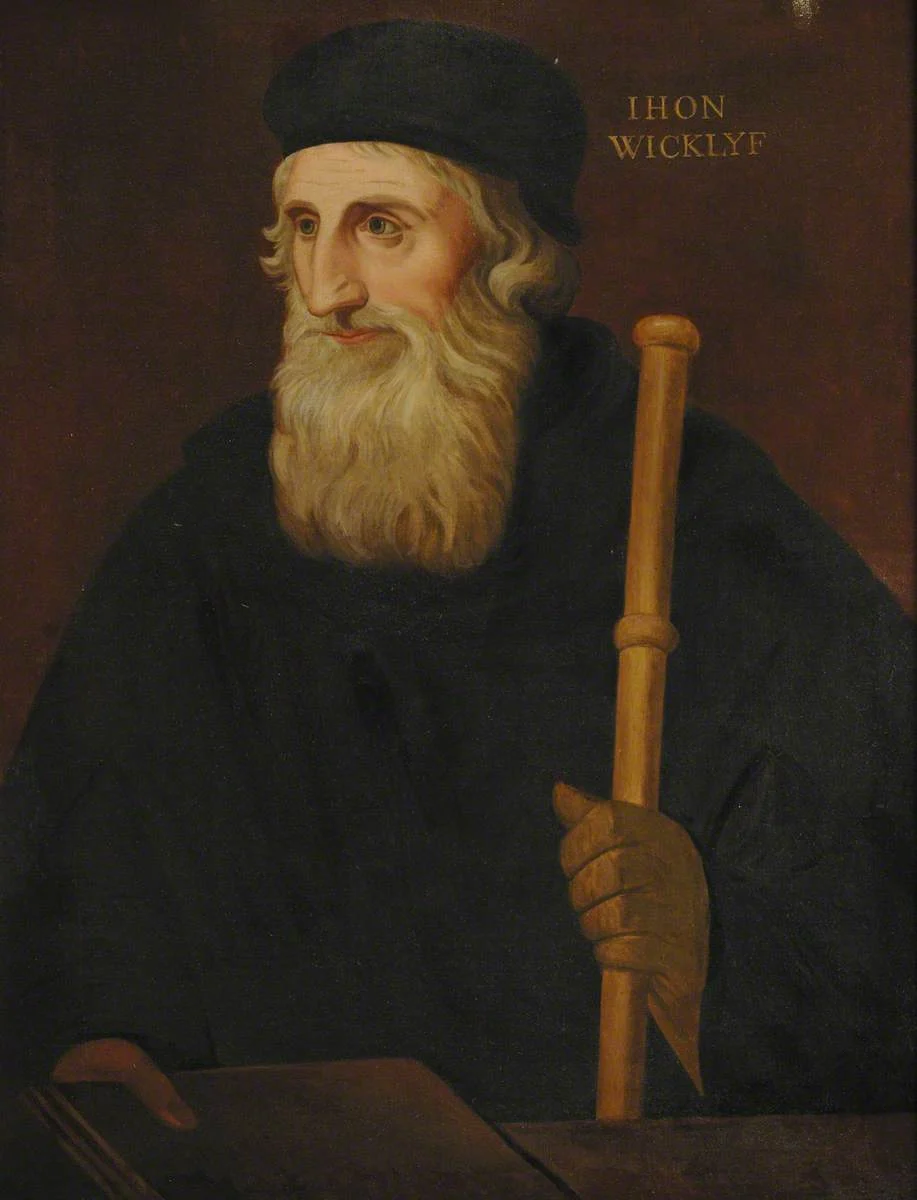
Public domain
John Wycliffe
1330 – 1384
Also known as: John Wiclif, John de Wycliffe, John Wyclif, Doctor Evangelicus, Morning Star of the Reformation
Pre-Reformation — Bible/Doctrine
John Wycliffe was born around 1330 in Yorkshire, likely in the village of Wycliffe-on-Tees, into minor nobility that afforded him educational opportunities rare for his time. He arrived at Oxford University in the 1350s, earning his bachelor's degree in 1356 and his master's in 1360. Oxford became his intellectual home for over two decades, where he advanced through the academic ranks to become one of the university's most formidable theologians and philosophers. He held the living of Fillingham in Lincolnshire from 1361, later exchanging it for Ludgershall in Buckinghamshire, though he remained primarily at Oxford. In 1374 he was appointed to the rich living of Lutterworth in Leicestershire, which would become his base for the final decade of his life.
Wycliffe's theological formation was deeply rooted in scholastic philosophy, particularly the realism of Duns Scotus, but he increasingly challenged the dominant Thomistic synthesis of his day. His early academic work focused on logic and metaphysics, but by the 1370s he had turned to ecclesiology and biblical theology with devastating effect. He developed a doctrine of lordship that made all human authority, including that of the church, contingent upon divine grace and moral worthiness. This led him to challenge papal authority, the temporal wealth of the church, and eventually transubstantiation itself.
The turning point came in 1377 when Pope Gregory XI issued five bulls condemning eighteen of Wycliffe's propositions. The condemnation drove him from Oxford, but also freed him to pursue his most radical work. At Lutterworth he gathered around himself a group of poor preachers, later dubbed Lollards, whom he trained to carry his teachings throughout England. His final years were marked by increasing isolation from ecclesiastical authority and growing influence among the common people. He suffered a stroke while hearing Mass on December 28, 1384, and died three days later. His enemies were not finished with him: the Council of Constance condemned him posthumously in 1415, and in 1428 his bones were exhumed, burned, and cast into the River Swift.
His Writing and Its Influence
Wycliffe began his serious theological writing in the 1370s, producing a massive corpus that included major works on civil and divine lordship, the church, Scripture, and the Eucharist. His Latin treatises, including "On Civil Lordship" and "On the Church," laid the theoretical groundwork for challenging papal supremacy and clerical wealth. But his most revolutionary contribution was his insistence that Scripture alone held final authority in matters of faith and practice. This led him to undertake the first complete translation of the Bible into English, completed around 1382 with the help of collaborators including Nicholas of Hereford and John Purvey.
The English Bible was Wycliffe's most dangerous legacy. By making Scripture accessible to laypeople in their own language, he undermined the church's monopoly on biblical interpretation and religious authority. The translation work continued after his death, with Purvey producing a revised version around 1388 that became the standard Wycliffite text. Despite official suppression and the burning of copies, the Bible survived in nearly two hundred manuscripts, testimony to its underground circulation.
Wycliffe's influence proved more durable than his contemporary opponents imagined. His writings reached Bohemia through the marriage connections between England and Bohemia, profoundly shaping Jan Hus and the Hussite movement. A century later, the Protestant reformers recognized him as a forerunner, with Luther and others hailing him as the "morning star of the Reformation." His core insights — the primacy of Scripture, the priesthood of all believers, and the church as the invisible company of the elect rather than a visible institution — became foundational to Protestant theology.
Works by John Wycliffe
Most of Wyclif is in Latin, and his English is fourteenth-century, so every way in asks some effort. Begin with the Wycliffe Bible, the work his name carries, and the Select English Works, his English sermons and tracts (Arnold's third volume holds the shorter pieces). Readers of Latin should take On the Truth of Holy Scripture, then On the Church and On the Eucharist; the Trialogus gathers his whole thought at the end of his life.
- On Civil Lordship 1376 – 1378
- Latin Sermons 1376 – 1384
- Polemical Works 1378 – 1384
- Wyclif's Wicket 1378 – 1384
- Select English Works 1380 – 1384
- Wycliffe Bible 1380 – 1395
- Trialogue 1382 – 1384
- The Gospel Work 1383 – 1384
Doubtful and spurious works
Works that have circulated under John Wycliffe’s name. Disputed: scholars question whether John Wycliffe wrote it. Spurious: judged not to be by John Wycliffe.
Todd (1840) prints it as Wyclif's but allows the ascription rests on Bale's authority alone; its date, 1356, falls before any of his known writings.
Todd's own title, 'An Apology for Lollard Doctrines, attributed to Wicliffe' (Camden Society, 1842); the attribution is argued in his introduction, not established.
Author unknown.
Arnold, Select English Works vol. I, pp. iv-v: ascribed to Wyclif by Bale, Lewis and Vaughan 'without cause', as Shirley first showed, Bishop Pecock having said a mendicant friar wrote it; Lechler's index: 'Poor Caitiff, not W.'s'.
Influence
Who shaped John Wycliffe, and who John Wycliffe shaped. Each line is drawn from the research behind the catalogue; the evidence sits in the catalogue, not on this page.
Influenced by
- Jerome 347–420 through Vulgate
- Augustine of Hippo 354–430
- William of Ockham 1287–1347 responded to
- Thomas Bradwardine 1290–1349
Influenced
- Jan Hus 1372–1415 through On the Church
Resources
- John Wyclif (Stanford Encyclopedia of Philosophy) Academic
- John Wyclif (Catholic Encyclopedia, 1912, vol. 15) Academic
- H. B. Workman, John Wyclif: A Study of the English Medieval Church, vol. 1 (Oxford, 1926), Internet Archive Biography
- G. V. Lechler, John Wycliffe and his English Precursors, tr. Lorimer (1884), Internet Archive Biography
Catalog IDA.J76F67.C