

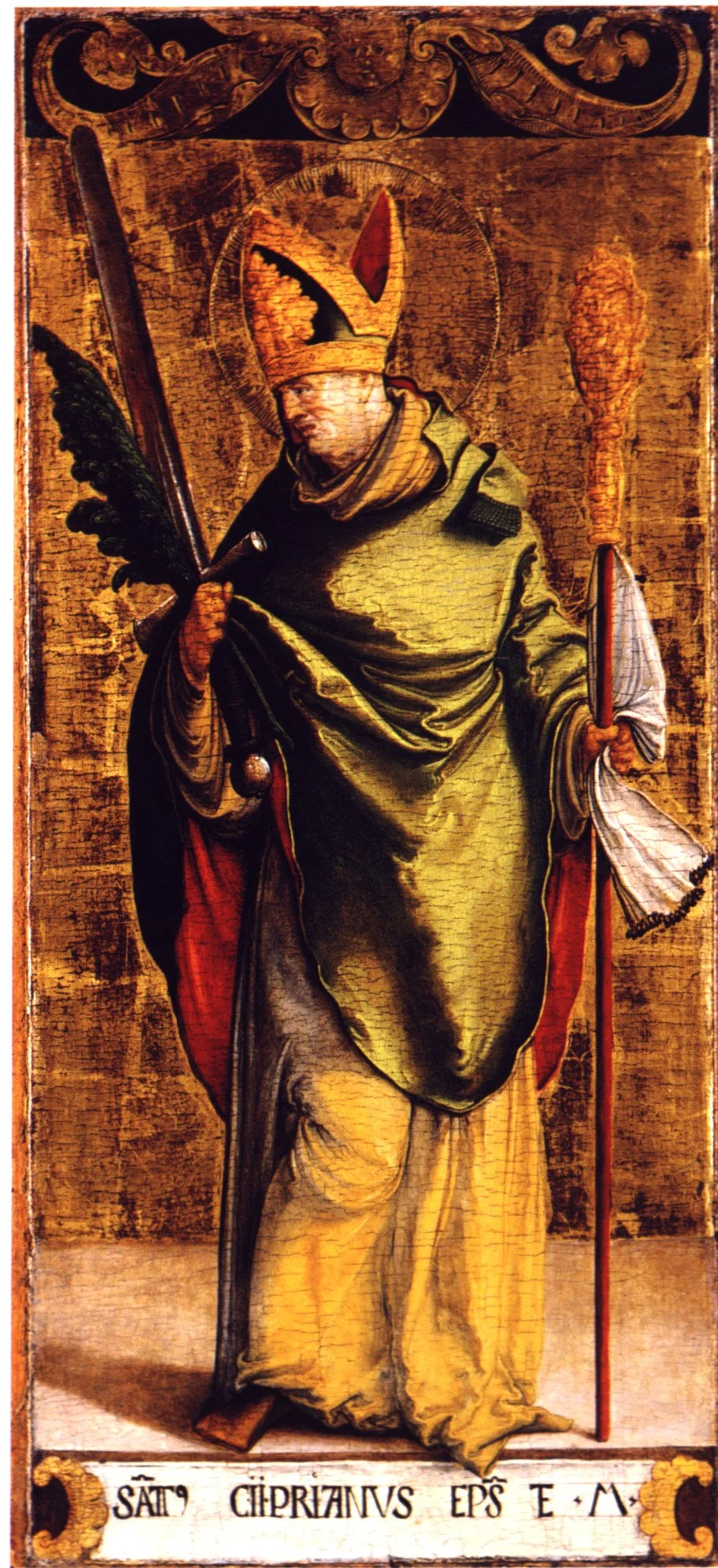
Public domain
Cyprian of Carthage
200 – 258
Also known as: Thascius Caecilius Cyprianus, Saint Cyprian, Cyprian, Cyprianus
Patristic — Pastoral/Theology
Thascius Caecilius Cyprianus was born in the early third century into the wealthy, educated circles of Roman North Africa, probably at Carthage. He was an orator and a teacher of rhetoric there before his conversion; Jerome says that the presbyter Caecilius brought him to the faith and that Cyprian took his name, and that he gave his wealth to the poor (Lives of Illustrious Men 67). In To Donatus, written soon after his baptism in about 246, he tells how "the Spirit breathed from heaven" gave him a second birth that "restored me to a new man." His deacon Pontius records that he was chosen bishop of Carthage while he was still a neophyte, in about 248.
At the end of 249 the persecution under Decius began, requiring every inhabitant of the empire to sacrifice to the gods. Cyprian withdrew from the city and governed his church by letter from hiding, a step he defended in his letters and that Pontius presents as made at God's command. The persecution left the question that filled his episcopate: what to do with the lapsi, the Christians who had sacrificed, or bought certificates saying they had, and who now asked to be received back. Against confessors who readmitted them at once, and against Novatian and his followers, who would not readmit them at all, Cyprian and the councils of African bishops required penance, with the bishops judging each case.
From 255 he was in dispute with Stephen, bishop of Rome, over the baptism of heretics. Cyprian and the African councils, the last of them on 1 September 256, held that baptism given outside the church was no baptism and must be given to those who came over from a schism or heresy; Stephen held that such converts should be received with the laying on of hands, and threatened to break communion with the churches that baptized them again (Eusebius, Church History 7.5). The quarrel ended without a final break: Stephen died in 257, and Pontius calls his successor Xystus "the good and peace-making priest." Under the emperor Valerian, Cyprian was sent into exile at Curubis in 257, recalled the next year, and beheaded at Carthage on 14 September 258. Pontius calls him the first bishop in Africa to receive the martyr's crown.
His Writing and Legacy
His treatises were written to the needs of his church: On the Lapsed and On the Unity of the Church after the persecution; On Mortality during the plague that reached Carthage in 252; On the Lord's Prayer and On Works and Alms; On the Advantage of Patience and On Jealousy and Envy in the years of the dispute over baptism; and To Demetrianus, against a pagan who blamed the Christians for the troubles of the age. Eighty-one letters of his correspondence survive, some of them written to him by the clergy of Rome, by Cornelius of Rome and by Firmilian of Caesarea, and they are the fullest record of any church of the third century. The letter to Jubaianus contains the sentence "there is no salvation out of the Church" (Epistle 72 in the Ante-Nicene Fathers), and On the Unity of the Church the saying that "he can no longer have God for his Father, who has not the Church for his mother."
He read Tertullian every day: an old man who had been his secretary told Jerome that Cyprian would call for his books with the words "Give me the master" (Lives of Illustrious Men 53). His own Latin is smoother, and Jerome compares him to "a fountain of pure water" that "flows softly and sweetly" (Letter 58). Lactantius admired his eloquence but held that he should have answered pagans from reason rather than from Scripture (Divine Institutes 5.1 and 5.4). Augustine, answering the Donatists who claimed Cyprian for their side, weighed his letters and his council one by one in On Baptism, against the Donatists, and wrote: "The authority of Cyprian does not alarm me, because I am reassured by his humility."
Works by Cyprian of Carthage
Begin with To Donatus, the short letter in which he describes his conversion, and then On the Lord's Prayer. On the Lapsed and On the Unity of the Church come next, both written in 251 after the Decian persecution, and his Letters tell the story of those years in his own words.
Disputed works
Works that have circulated under Cyprian of Carthage’s name. Disputed: scholars question whether Cyprian of Carthage wrote it.
Authorship disputed: accepted as Cyprian's by Benson, Monceaux and Bardenhewer, given to Novatian by Haussleiter and rejected by Harnack, Watson and von Soden (Catholic Encyclopedia, 1908, "St. Cyprian of Carthage").
Influence
Who shaped Cyprian of Carthage, and who Cyprian of Carthage shaped. Each line is drawn from the research behind the catalogue; the evidence sits in the catalogue, not on this page.
Influenced by
- Minucius Felix 150–250
- Tertullian 160–225
- Novatian 200–258 responded to through Letters
Influenced
- Lactantius 250–325 was answered by through To Demetrian
- Augustine of Hippo 354–430
- Pontius the Deacon
- Vincent of Lérins ?–445 was answered by
Resources
Catalog IDA.WBVSJP.9