

Public domain · Research complete
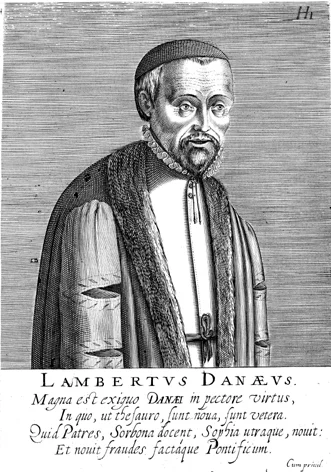
Lambert Daneau
1530 – 1595
Also known as: Lambertus Danaeus, Daneau, Lambert
Reformed — Theology
Lambert Daneau (c. 1530–1595)
Lambert Daneau, who signed his Latin books Lambertus Danaeus, was born about 1530 at Beaugency on the Loire, the son of Lambert Daneau, sieur de La Grange, a revenue officer of the town, and Agnès Brachet, of an Orléans family. His father died young: by 1543 his mother was a widow, and her brother Antoine Brachet was the boy's guardian. He studied at Orléans and then at Paris, where he heard Adrien Turnèbe at the Collège Royal, and from about 1553 he followed the law lectures of Anne du Bourg at Orléans. He took his licence in law there in November 1557, twice sought a chair in the faculty without success, and went on to Bourges, where he studied under the jurist Hugues Doneau; he was a doctor of laws by the beginning of 1560.
Du Bourg was put to death in Paris on 23 December 1559 for his Protestant faith, and his biographer Paul de Félice judged that his teacher's death brought Daneau openly into the Reformed church. He reached Geneva on 24 April 1560, stayed most of a year, and under Calvin's influence gave up the law for theology.
Before Easter 1561 the church of Orléans sent him as pastor to Gien, on the Loire, and he served there until 1572, through the first wars of religion. In a letter of 1576 to Girolamo Zanchi he wrote that in those twelve years he had been driven out, recalled, condemned and acquitted more than seven times. The governor Martinengo imprisoned him at Gien, and he wrote his treatise on Christian friendship in that prison; he lost his books and some of his manuscripts in 1568 and again in 1572. The national synod of La Rochelle in 1571 named him among the ministers charged with answering the books of the church's opponents. After the Saint Bartholomew's Day massacres of August 1572 he escaped to Geneva, where he was by 10 October.
Geneva made him pastor of the country parish of Jussy, then for a few weeks of Vandœuvres, and in June 1574 a pastor in the city, so that he could also teach theology; he had been lecturing since 1573. Poor health led to his release from the ministry in 1576, and he kept his post as professor. He was a friend of Theodore Beza, who baptised two of his children. On 3 May 1573, in his second marriage, he had married Claude Péguy, the daughter of a refugee from Orléans; at least six children were born to them, of whom only Marie and Josias outlived him. Geneva received him as a citizen in January 1581.
In February 1581 he left for the new University of Leiden, as professor of theology and pastor of its Walloon church. His wish to order that congregation on the Genevan pattern, and the authority the city's magistrates claimed over the government of the church, set him against them; when a councillor compared the discipline of Geneva to the Spanish Inquisition, he asked to leave, and the prince of Orange urged the city to keep him. He left Leiden in May 1582. On his way back to France he stopped at Ghent at the request of its pastors and magistrates, and taught and preached there for a year, leaving in May 1583 with a gift from the city. He then went to the Reformed academy of Orthez in Béarn, under Henri of Navarre, who in 1585 ordered him a silver ewer as a present, and he moved with the academy to Lescar in 1591. In October 1593 he went to Castres, at the call of its consistory, as pastor and professor. He fell ill there in the autumn of 1595 and died at Castres on 11 November 1595.
His Writing and Its Influence
De Félice counted sixty-seven printed works. The first were French translations made at Gien: Tertullian on the dress of Christian women (1565), treatises of Cyprian (1566) and Hesiod's Works and Days in verse (1571). The Elenchi haereticorum, on how the arguments of heretics may be detected and answered, followed in 1573, and most of his writing came out at Geneva over the next eight years, much of it from the press of Eustache Vignon.
Part of it addressed the conduct of church members. Les Sorciers (1574), a dialogue on witchcraft, appeared the same year in Latin as De veneficis and in English in 1575 as A Dialogue of Witches; treatises on games of chance, on Christian friendship, on dancing and on Christians' dress followed. Another part set out disciplines from Scripture. The Physica Christiana (1576) is a Christian natural philosophy, and its second part follows the six days of creation; Thomas Twyne put the first part into English as The Wonderfull Woorkmanship of the World (1578). The Ethices christianae libri tres (1577) treat the principles of human action and explain the Decalogue, and the Politices christianae was published in 1596, after his death.
He wrote a Methodus for handling Scripture in lectures and sermons, with a commentary on Philemon as its example, and commentaries on 1 Timothy, the Minor Prophets, Matthew, Mark, the Gospel and Epistles of John, and Jude. In 1580 he published a commentary on the first book of Peter Lombard's Sentences, and from 1583 to 1588, with a preface by Beza, the Christianae isagoges, a body of doctrine arranged by commonplaces. The Tractatus de Antichristo (1576) set out the place, time and form of the kingdom of Antichrist from Scripture.
Much of the rest was controversy. On the Lord's Supper and the person of Christ he answered the Lutheran theologians Lucas Osiander, Nikolaus Selnecker, Jakob Andreae, Martin Chemnitz and Stephan Gerlach; on the Trinity, the Catholic Gilbert Génébrard; Dirck Coornhert; and at the end of his life Robert Bellarmine's Disputations, a reply left unfinished at his death and printed in 1596. In 1583 he gathered his shorter theological writings, revised, as the Opuscula omnia theologica.
De Félice found that few of his books had fewer than two editions. Several went into English in Elizabethan London: besides the dialogue on witches and the Christian physics, the treatise on Christian friendship with the one on dice-play (1586), the treatise on Antichrist (1589) and the commentary on the Minor Prophets (1594); others went into German and Dutch. In 1596 Jean Gigord taught theology by expounding one of his works, and in 1626 the national synod of Castres asked his son to collect his writings and publish them at the synod's cost. Sénebier, in his literary history of Geneva, judged his many volumes of little use; de Félice's study of 1881 gathered his life, his works and his unpublished letters.
Works by Lambert Daneau
In English, begin with True and Christian Friendship and A Dialogue of Witches, both printed in London in Elizabethan translations; A Treatise Touching Antichrist and A Fruitful Commentary upon the Twelve Small Prophets show his doctrine and his exegesis. In Latin, the Ethices christianae libri tres and the Christianae isagoges carry his ethics and his body of doctrine.
- Reply to Gerlach 1581
- Quicklime 1582
- Questions on Matthew 1588
- The Life of St Paul 1595
Influence
Who shaped Lambert Daneau, and who Lambert Daneau shaped, and who worked beside Lambert Daneau. Each line is drawn from the research behind the catalogue; the evidence sits in the catalogue, not on this page.
Influenced by
- Augustine of Hippo 354–430
- Peter Lombard 1100–1160 responded to
- John Calvin 1509–1564
- Martin Chemnitz 1522–1586 responded to
- Nikolaus Selnecker 1530–1592 responded to
- Robert Bellarmine 1542–1621 responded to
Worked with
- Theodore Beza 1519–1605
Resources
Catalog IDA.6HBT0A.1