

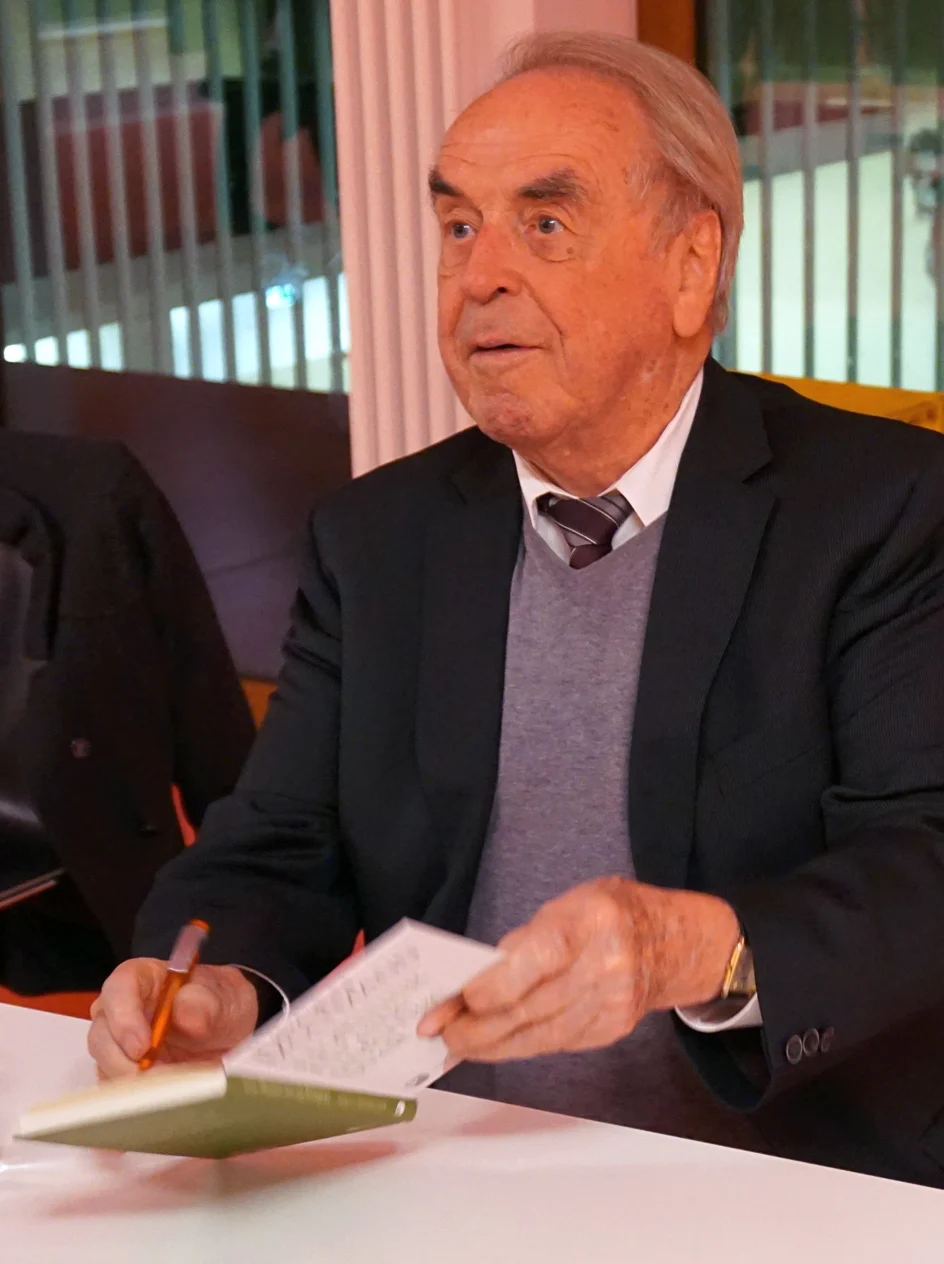
In copyright
Jürgen Moltmann
1926 – 2024
Also known as: Juergen Moltmann
Reformed — Theology
Jürgen Moltmann (1926–2024)
Jürgen Moltmann was born on April 8, 1926, in Hamburg, into a secular, educated household that held little interest in Christianity. His father was a teacher; the family's real religion was the German humanist canon, Goethe and Nietzsche and the physics that his mathematical gifts inclined him toward. He planned to study mathematics and physics. That plan ended on the night of July 1943, when the Allied firestorm that destroyed Hamburg killed the schoolmate standing beside him. He was sixteen. He later recalled crying out to God that night, asking where he was in the fire, and it was the first prayer of his life. It was a question, not a conversion, and it would take a decade to be answered.
He was drafted in 1944, served as an anti-aircraft auxiliary, and in early 1945 surrendered to British troops near Goch in the Netherlands. The three years that followed were the real beginning of his theology. He was held in prisoner-of-war camps in Belgium and Scotland, ending at Norton Camp in Nottinghamshire, where he lived behind wire among men who had lost their country, their families, and their sense of meaning together. An American chaplain handed him a Bible. He read the Psalms of lament and the passion narrative in Mark and found, in the cry of dereliction, a God who had been in the fire after all, not above it. He has described that recognition as being "found" rather than finding, and the phrase marks the posture of everything he later wrote. Camp life also gave him his first theological conversations and his first sight of Christians from the churches who treated prisoners as persons. Prisoners in Norton Camp were allowed to study; he read Reinhold Niebuhr and Dietrich Bonhoeffer there, and the camp's informal theological school was where he decided to study theology.
Released in 1948, he enrolled at Göttingen, where he studied under Otto Weber, Hans Joachim Iwand, Ernst Wolf, and Gerhard von Rad. He took his doctorate in 1952 with a dissertation on Reformed theology, and his early work was shaped by the Reformed tradition's attention to covenant, election, and the sovereignty of God, filtered through Karl Barth's reconstruction of it. He was ordained in the Evangelical Church of Bremen and served from 1953 as pastor in the village of Wasserhorst, a rural parish where he also began to understand the church as a community of ordinary people rather than a seminar. In 1958 he moved to teach at the church's theological school in Wuppertal, then in 1963 to the University of Bonn, and in 1967 to Tübingen, where he held the chair of systematic theology until his retirement in 1994. He spent his career within the German university church, never an outsider to it, though not always at ease inside it.
His work took shape in a time of ideological conflict. Ernst Bloch's The Principle of Hope, which Moltmann read as a young professor, and the Marxist-Christian dialogue it opened across the Iron Curtain, pushed him toward a theology of the future that critics on both flanks found suspect. The Protestant establishment thought he had ceded too much to Marxism; Marxists thought he baptized a hope they could not share. Family life gave the work a second pulse. He married Elisabeth Wendel in 1952, herself a theologian who would become a feminist voice in German Protestantism, and their partnership was one of mutual criticism as much as affection. Their daughters were part of the household that shaped his later thinking on the Spirit and on community.
He retired in 1994 but continued to lecture and publish across the world for another three decades. Elisabeth died in 2016. Moltmann died in Tübingen on June 3, 2024, at ninety-eight.
His Writing and Its Influence
Moltmann began publishing in the late 1950s, but the work that made his name appeared in 1964 as Theology of Hope. Its argument was that Christian eschatology had been misplaced: treated as the last chapter of dogmatics, a tidy appendix on final things, when it was in fact the medium of all Christian theology. The resurrection of the crucified Christ, he argued, is God's promise of a future that contradicts the present, and the church exists as a community moving toward that promise rather than as a guardian of the established order. Bloch supplied the vocabulary of hope; Barth's Reformed seriousness about the God who speaks and acts supplied the ground beneath it. The book was received as an event, discussed from Tübingen to Latin America, and it gave him a reputation he would spend decades both fulfilling and complicating.
The Crucified God followed in 1972 and is the book many readers consider his deepest. Here the cry of dereliction, the text that had held him in Norton Camp, becomes the center of a doctrine of God. Moltmann argued that the cross is an event between the Father and the Son, and that God does not stand outside suffering as an unmoved observer but takes it into the divine life. Critics accused him of compromising the classical doctrine of divine impassibility, and some Reformed and Catholic readers found his language of God's suffering dangerously loose. He held his ground, and the book's reception carried an irony: a theology born in a prisoner-of-war camp and written amid the ruins of postwar Germany spoke to Christians in situations of political violence far from Europe, becoming a resource for Latin American liberation theologians and for those living under dictatorship and apartheid.
From the 1980s he turned to an ambitious series of systematic contributions, beginning with The Trinity and the Kingdom in 1980, in which he developed a social doctrine of the Trinity, reading the three persons as a community of mutual indwelling rather than a single divine subject. God in Creation brought ecology into dogmatics, The Way of Jesus Christ reworked Christology, and The Spirit of Life offered a doctrine of the Spirit that gave a place to experience and to the body. The Coming of God returned to eschatology in 1995 and revisited the questions that had started him. His late books, including Ethics of Hope, kept faith with the same conviction. He wrote as a systematic theologian who refused system's closure, preferring what he called experiments in theology to a final summa.
His influence was wide and uneven. Liberation, political, and feminist theologies drew on him, as did ecumenical dialogue and the Christian-Jewish conversation after the Holocaust. Evangelical readers in the English-speaking world discovered him later, drawn by his emphasis on the Spirit, though many remained wary of his universalist leanings in the doctrine of final reconciliation. Some Reformed critics found him too far from the confessions he had been trained in. Rehabilitation here is less a matter of being condemned and restored than of being absorbed: much of what once seemed radical in his work, from the church's mission as participation in God's future to the suffering of God, became common property in contemporary theology.
Influence
Who shaped Jürgen Moltmann, and who Jürgen Moltmann shaped. Each line is drawn from the research behind the catalogue; the evidence sits in the catalogue, not on this page.
Influenced
- Richard Bauckham 1946–?
Catalog IDA.29BY0E.P