

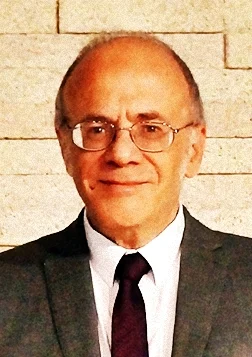
In copyright
Richard Bauckham
b. 1946
Also known as: Richard J. Bauckham
Evangelical — Biblical Studies
Richard John Bauckham was born on September 22, 1946, in London, England. His academic journey began at Clare College, Cambridge, where he read Natural Sciences before shifting to theology, completing his BA in 1967 and PhD in 1973. His doctoral dissertation examined the theology of Jürgen Moltmann, marking the beginning of a lifelong engagement with contemporary theological movements alongside rigorous historical scholarship.
Bauckham's early career unfolded at the University of Leeds, where he taught in the Department of Theology and Religious Studies from 1973 to 1992, rising to Professor of Historical Theology. During these years he established himself as a formidable scholar of early Christianity, Second Temple Judaism, and patristic theology. In 1992 he moved to the University of St. Andrews in Scotland, taking the chair in New Testament Studies, where he remained until his retirement in 2007. Throughout his academic career, Bauckham maintained strong evangelical convictions while engaging seriously with critical scholarship, often finding himself defending traditional Christian claims through sophisticated historical argument rather than confessional assertion.
His theological formation drew heavily from Reformed traditions, particularly Karl Barth, though he was equally shaped by his encounter with liberation theology and contemporary biblical criticism. Bauckham's distinctive contribution lay in his ability to deploy rigorous historical-critical methods in service of essentially conservative conclusions about early Christian texts and beliefs. This approach sometimes put him at odds with both skeptical scholars who found his conclusions too traditional and conservative evangelicals who viewed his methods with suspicion. His work on the historical reliability of the Gospels, particularly his argument for eyewitness testimony underlying the Gospel narratives, exemplified this tension.
His Scholarship and Influence
Bauckham's prolific writing career spans over four decades, encompassing more than thirty books and hundreds of articles. His early works included studies of Tudor apocalyptic thought and Moltmann's theology, but his most influential contributions emerged in New Testament studies and early Christian history. "The Theology of Revelation" (1993) offered a comprehensive commentary on the Apocalypse that combined careful exegesis with theological reflection. "The Climax of Prophecy" (1993) further established his reputation in Johannine studies.
His most widely read work, "Jesus and the Eyewitnesses" (2006), argued that the Gospels preserve eyewitness testimony about Jesus, challenging the scholarly consensus that dismissed such connections as legendary. The book sparked significant debate, with Bauckham employing form criticism, literary analysis, and social memory theory to support his thesis. Critics questioned his methodology and conclusions, while supporters praised his innovative approach to Gospel origins.
Bauckham's biblical theology consistently emphasized the particularity of the biblical narrative while maintaining its universal significance. His work on the identity of Jesus, early Christology, and Jewish-Christian relations demonstrated deep learning in Second Temple literature and patristic sources. "The Bible and Ecology" (2010) revealed his environmental concerns, arguing for a biblical foundation for ecological responsibility.
His influence extends beyond academia through popular-level works and his involvement in evangelical theological discussions. Bauckham served on the editorial boards of several journals and contributed to various theological societies. His retirement has not diminished his output, with continued publishing on biblical theology and hermeneutics.
Works by Richard Bauckham
Begin with Jesus: A Very Short Introduction, a clear historical portrait in a hundred pages, or At the Cross for a devotional way in. Then read The Theology of the Book of Revelation and God Crucified; Jesus and the Eyewitnesses, his best-known and longest argument, comes after them.
- Tudor Apocalypse 1978
- Jude, 2 Peter 1983
- Bible in Politics 1989
- Freedom to Choose 1991
- Climax of Prophecy 1993
- Theology of the Book of Revelation 1993
- God Crucified 1998
- Fate of the Dead 1998
- At the Cross 1999
- Hope against Hope 1999
- Gospel Women 2002
- Bible and Mission 2003
- Jesus and the Eyewitnesses 2006
- Bible and Ecology 2010
- Jesus: A Very Short Introduction 2011
- Gospel of Glory 2015
- Who Is God? 2020
- Tumbling into Light 2022
- The Blurred Cross 2024
About & Related Works
Works about Richard Bauckham, plus compilations, editions and commentary — offered as resources, not as their own writing.
- A Cloud of Witnesses 2008
- Magdala of Galilee 2018
Influence
Who shaped Richard Bauckham, and who Richard Bauckham shaped. Each line is drawn from the research behind the catalogue; the evidence sits in the catalogue, not on this page.
Influenced by
- Jürgen Moltmann 1926–2024
Resources
- Richard Bauckham (author's website) Organization
- Richard Bauckham: books (author's bibliography) Bibliography
- Professor Richard Bauckham: profile, Ridley Hall, Cambridge Biography
Catalog IDA.G22AZ0.B