

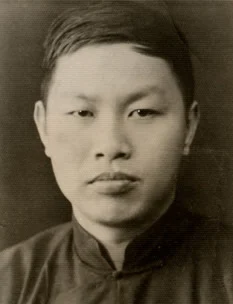
In copyright
Watchman Nee
1903 – 1972
Also known as: Ni Tuosheng, Henry Nee, Nee To-sheng
Evangelical — Spiritual Formation
Ni Tuosheng, known to the English-speaking world as Watchman Nee, was born on November 4, 1903, in Fuzhou, in China's Fujian Province. He was the third of nine children in a family where Christian faith had recently taken root through his maternal grandfather, a Congregational minister. His mother, Lin Heping, was herself a devout believer who led her son to faith during his teenage years. The conversion came through the persistent witness of a classmate, Dora Yu, during his time at Trinity College, a Methodist mission school in Fuzhou. He was seventeen when he surrendered to Christ, and the transformation was immediate and radical — burning his novels and abandoning his academic ambitions to pursue what he would later call "the recovery of the church."
Nee's theological formation came not through seminary but through voracious reading and correspondence with foreign missionaries and writers. He was particularly influenced by the Plymouth Brethren, especially the writings of John Nelson Darby and G.H. Pember. The Keswick movement's emphasis on the "deeper life" shaped his understanding of Christian experience, while the writings of Jessie Penn-Lewis, T. Austin-Sparks, and D.M. Panton provided him with frameworks for understanding spiritual warfare and church life. By his early twenties, he had begun gathering believers in Fuzhou who shared his conviction that denominational Christianity had departed from New Testament patterns.
The local churches movement that emerged under Nee's leadership represented a radical attempt to restore what he saw as biblical church practice — each city having only one church, meeting in homes, with no professional clergy or denominational structures. Beginning in 1922, he started a magazine called "The Christian" to spread these teachings across China. His work attracted both devoted followers and sharp criticism from established missions. The movement grew rapidly through the 1930s and 1940s, establishing churches in major Chinese cities and developing a distinctive emphasis on the subjective experience of Christ and the corporate expression of the body of Christ.
Nee's later years were marked by increasing pressure from the Chinese Communist government. In 1952, he was arrested and imprisoned on charges of espionage and corruption. He spent the final twenty years of his life in prison, maintaining his faith despite intense persecution and pressure to renounce his beliefs. He died in prison on May 30, 1972. A note found in his Bible after his death read: "Christ is the Son of God who died for the redemption of sinners and resurrected after three days. This is the greatest truth in the universe. I die because of my belief in Christ." His physical circumstances had not diminished his spiritual convictions.
His Writing and Its Influence
Nee began writing in the 1920s with his magazine "The Christian," which became the primary vehicle for his teachings until its suppression by the Communist government. His major works emerged from messages delivered to the churches and conferences, later compiled into books. "The Spiritual Man," published in Chinese in the 1920s and translated into English in the 1960s, remains his most systematic work — a detailed exploration of the tripartite nature of man as spirit, soul, and body. "The Normal Christian Life," based on Romans 6-8, presents his understanding of identification with Christ in death and resurrection as the foundation of Christian experience.
"Sit, Walk, Stand," drawn from Ephesians, offers his mature teaching on the believer's position, conduct, and warfare. "The Release of the Spirit" examines the brokenness necessary for spiritual effectiveness, while "Love Not the World" analyzes the satanic world system. His church-life trilogy — "The Normal Christian Church Life," "The Orthodoxy of the Church," and "Rethinking the Work" — articulates his vision for New Testament church practice and the recovery of proper church ground.
Nee's influence extended far beyond China through English translations of his works, published primarily by Christian Fellowship Publishers. His teachings on the exchanged life, the centrality of Christ, and church practice have influenced renewal movements, house church networks, and individual believers across denominational lines. The Local Church movement continues his emphasis on the church as the expression of Christ in each locality, though it has faced controversy over authoritarian practices and exclusive claims. His integration of Plymouth Brethren ecclesiology with Keswick spirituality created a distinctive synthesis that continues to attract readers seeking both personal spiritual depth and corporate church expression.
Works by Watchman Nee
Begin with The Normal Christian Life, his best-known book and the clearest statement of his message of the cross and life in Christ. Then Sit, Walk, Stand, short and simple, and The Release of the Spirit for those in Christian service. The Spiritual Man, his one systematic book, is long and demanding; read it last.
- The Spiritual Man 1928 – 1929
- The Assembly Life 1938
- Sit, Walk, Stand 1957
- Love Not the World 1968
- Spiritual Authority 1972
- Spiritual Knowledge 1973
- God's Work 1974
- Come, Lord Jesus 1976
- Let Us Pray 1977
- The Testimony of God 1979
- Whom Shall I Send? 1979
- The New Covenant 1981
- Aids to "Revelation" 1983
- Grace for Grace 1983
- From Faith to Faith 1984
- From Glory to Glory 1985
- Back to the Cross 1988
- Interpreting Matthew 1989
- Worship God 1990
- Take Heed 1991
- Revive Thy Work 1996
- Serve in Spirit 2009
- Amazing Grace 2013
Influence
Who shaped Watchman Nee, and who Watchman Nee shaped. Each line is drawn from the research behind the catalogue; the evidence sits in the catalogue, not on this page.
Influenced by
- Madame Jeanne Guyon 1648–1717
- Jessie Penn-Lewis 1861–1927 through The Spiritual Man
- T. Austin-Sparks 1888–1971
Influenced
- Witness Lee 1905–1997
Resources
Catalog IDA.XZ7W1B.A