

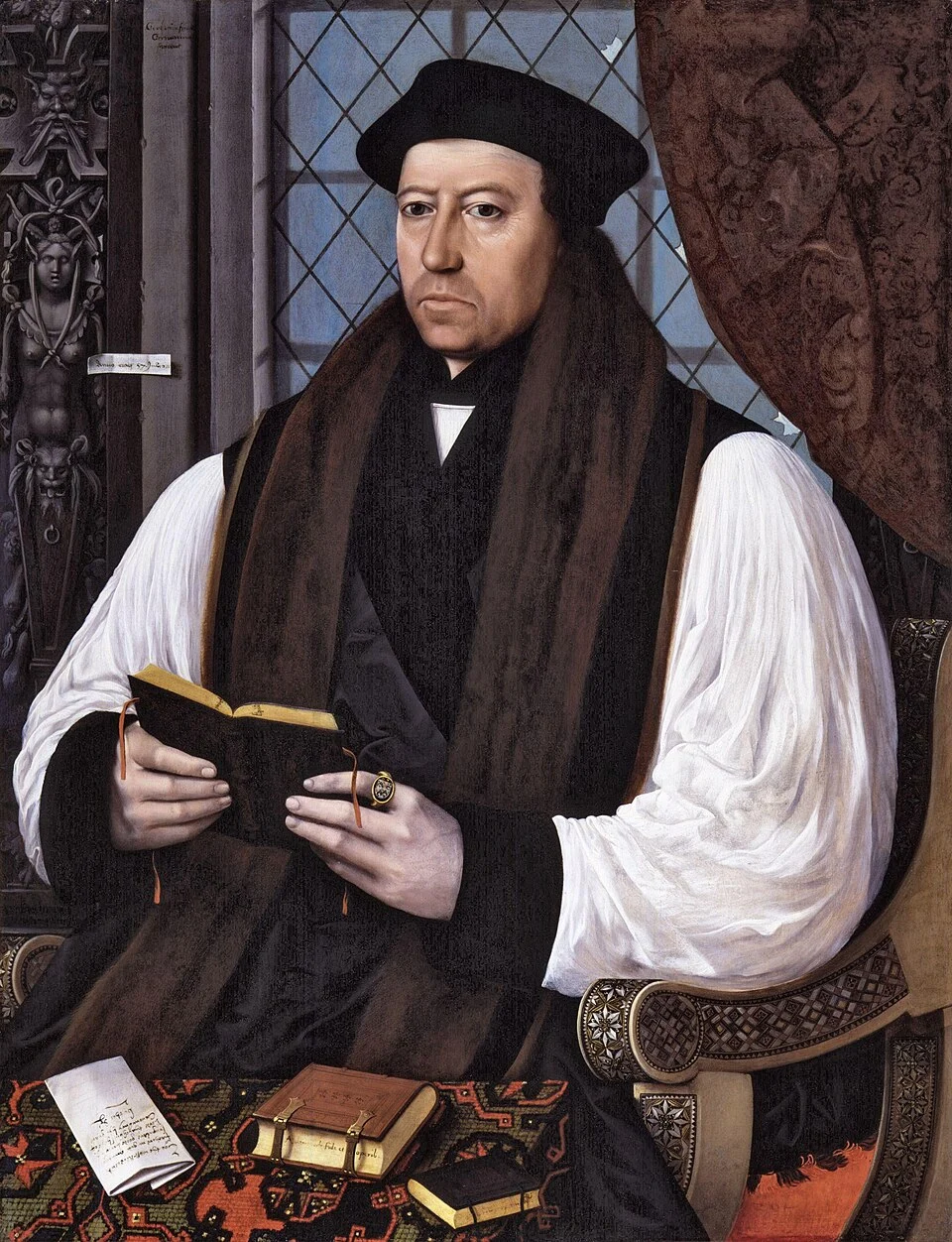
Public domain
Thomas Cranmer
1489 – 1556
Also known as: Archbishop Cranmer, Saint Thomas Cranmer
Anglican — Liturgy/Theology
Thomas Cranmer was born in 1489 at Aslacton in Nottinghamshire. At Jesus College, Cambridge, he took his first degree in 1510 or 1511 and was elected a fellow. He married Joan, a young relative of the mistress of the Dolphin Inn, and so lost his fellowship; he became common reader at Buckingham College, and when, about a year after the marriage, his wife died in childbed, Jesus College elected him again. He was a theologian, not a lawyer (the statutes of his college forbade the study of canon law), and was made doctor of divinity in about his thirty-fourth year.
In the summer of 1529, staying at Waltham in Essex while the plague was at Cambridge, he dined with Edward Fox and Stephen Gardiner. Asked about the king's divorce, he suggested taking the question out of the hands of the lawyers and putting it to the divines of the universities. The suggestion brought him into the king's service. In 1532 Henry sent him as ambassador to the Emperor Charles V. At Nuremberg he met the Lutheran pastor Andreas Osiander and married his host's niece, Margaret, though he was by then in priest's orders. He was consecrated Archbishop of Canterbury on 30 March 1533, pronounced against Henry's marriage to Catherine of Aragon, and on Whitsunday, 1 June, crowned Anne Boleyn in Westminster Abbey.
Under Henry VIII and then Edward VI he led the reform of the English church's worship and teaching. He wrote the preface to the Great Bible for its editions of 1540 and 1541, so that it was called "Cranmer's Bible"; in 1544, at the king's command, he translated Latin processions into English. He edited the first Book of Homilies (1547), three of which, on salvation, faith and good works, are his; published in 1548 an English translation of a Lutheran catechism by Justus Jonas; and led the making of the Books of Common Prayer of 1549 and 1552 and the Forty-two Articles of 1553. These, as Pollard writes, were "of composite authorship," but in them "Cranmer's voice sounded the dominant note." In his Defence of the True and Catholic Doctrine of the Sacrament (1550) and his Answer to Stephen Gardiner (1551) he set out his teaching on the Lord's Supper; in the Answer he said that shortly before the Catechism he had abandoned "that error of the real presence." In these years Martin Bucer came to teach at Cambridge and Peter Martyr at Oxford.
Trial and death
When Mary came to the throne in 1553 he was imprisoned, tried for heresy and degraded from his orders, and he signed a series of recantations. On 21 March 1556 he was brought to St Mary's Church, Oxford, to read the last of them before he was burned. Instead he renounced "all such bills which I have written or signed with mine own hand since my degradation," as "written for fear of death," and added: "forasmuch as my hand offended in writing contrary to my heart, it shall be first burned." He refused the Pope "as Christ's enemy and Antichrist," and said that of the sacrament he believed as he had taught in his book against the Bishop of Winchester. He was dragged from the stage and led out to the stake.
Works by Thomas Cranmer
Begin with A Prologue or Preface to the Great Bible, his short plea of 1540 for the reading of Scripture in English. Then read The Book of Common Prayer (1549) and A Defence of the True and Catholic Doctrine of the Sacrament, where his teaching on the Lord's Supper is set out at length.
- Works 1534 – 1556
Disputed works
Works that have circulated under Thomas Cranmer’s name. Disputed: scholars question whether Thomas Cranmer wrote it.
Printed in Mary's reign as "made by Thomas Cranmer" but "translated and set forth by E. P."; Jenkyns judged it "certainly was not 'made' by Cranmer in its present form" (quoted by Cox, Parker Society Works, vol. 2).
About & Related Works
Works about Thomas Cranmer, plus compilations, editions and commentary — offered as resources, not as their own writing.
Influence
Who shaped Thomas Cranmer, and who Thomas Cranmer shaped, and who worked beside Thomas Cranmer. Each line is drawn from the research behind the catalogue; the evidence sits in the catalogue, not on this page.
Influenced by
- Desiderius Erasmus 1466–1536
- Martin Bucer 1491–1551 through Book of Common Prayer
- Stephen Gardiner responded to through An Answer to a Crafty and Sophistical Cavillation
Worked with
- Hugh Latimer 1487–1555
- Peter Martyr Vermigli 1499–1562
- Nicholas Ridley 1500–1555
Resources
Catalog IDA.CQ4VKQ.B