

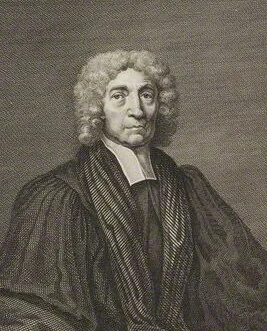
Public domain
John Strype
1643 – 1737
Also known as: Strype, John
Anglican — Church History
John Strype (1643–1737)
John Strype was born on November 1, 1643, in Stepney, then a village on the eastern edge of London, the son of John Strijpe, a Huguenot silk-throwster of Dutch descent who had settled in the parish, and Hester Strype, who came from Ludlow. His father had come over from Brabant, and the family name had been anglicized by the time John came to write. He grew up in the London of the Civil War and the Interregnum, a city of sectarian argument and printed controversy, and in later life he would describe himself as having lived through the greater part of the century's upheavals.
His schooling began at St Paul's School, whose master Samuel Cromleholme taught him, and he proceeded to Jesus College, Cambridge, before migrating to Catharine Hall, where he took his BA in 1665. He was ordained deacon and priest in the restored Church of England, and in 1669 he became curate at Theydon Bois in Essex. The following year he was appointed to the curacy of Leyton, also in Essex, and it was Leyton that became his home. In 1669 he was licensed as curate there, and from 1674 he held the perpetual curacy and lectureship; he was also made vicar of Low Leyton in 1689. He was a clergyman of modest means who served a country parish in an unremarkable place.
Strype's stability came through a patron. Sir William Hickes of Ruxley Lodge, and later the Hickes family connections, supported his study, and Strype's friendships among antiquarians and scholars, including the Cambridge historian Thomas Baker, gave him access to manuscript collections that others could not easily reach. He held to a sound Anglican position: conforming, loyal to the established church, and committed to the Reformation settlement as it had come to be understood in the reign of Elizabeth. His loyalties stayed with the established order even when the political ground shifted around him, through the reigns of Charles II, James II, William and Mary, Anne, and the first two Georges. Alongside his Leyton duties he was lecturer at Hackney and held other appointments; in 1711 he became rector of Terling in Essex, which he held with Leyton's lectureship. At Terling he lived and worked in his later decades.
The central discipline of his life was the collecting and transcription of historical documents. He copied letters, state papers, ecclesiastical records, and the private correspondence of Tudor churchmen, working from the libraries of Archbishop Parker's Corpus Christi, Cambridge, the Cotton collection, and the papers of Lord Burghley, among others. Strype did not write as a theologian or a mystic; his formation was that of a church historian convinced that the English Reformation was best understood through its own documents. Where he gave his opinions, they were the opinions of a moderate churchman who admired Cranmer, Parker, Grindal, and Whitgift, and who saw in their labours the foundation of a settled English church.
His inner life is largely hidden behind this work. We have little from him that is confessional or devotional, and he left no account of conversion or crisis. What the record shows is a long and orderly life lived in Essex parishes, devoted to labour that few of his contemporaries saw the point of. The cost was real in a quiet way: he worked for decades on editions and compilations that brought little financial reward, and he lived in modest circumstances, patronised by gentlemen who valued his learning more than they paid for it. He married, and his wife Susanna Lowe outlived him in the sense that his later years were spent in her company until she died; he outlived her and most of his friends.
He died on December 11, 1737, at Hackney, at the age of ninety-four, having outlived nearly every person who had known him as a young man. He was buried at Leyton, in the church he had served for so long.
His Writing and Its Influence
Strype's printed work began in the 1690s, when he was already past fifty, and it did not stop for forty years. His first substantial book was a life of Thomas Cranmer, Memorials of the Most Reverend Father in God Thomas Cranmer, published in 1694. It set the pattern for everything that followed: a narrative thread running through, and often buried beneath, long transcriptions of original letters, injunctions, examinations, and state papers. The Life of Sir Thomas Smith appeared in 1698, and the Life and Acts of Edmund Grindal in 1710. The Life of Matthew Parker followed in 1711, then the Life of Sir John Cheke in 1705 and the Life and Acts of John Whitgift in 1718. The grandest undertaking was Annals of the Reformation and Establishment of Religion, issued in four volumes between 1709 and 1731 and covering the reign of Elizabeth. He also produced Ecclesiastical Memorials, in three volumes (1721), treating the reigns of Henry VIII, Edward VI, and Mary, and an enlarged edition of Stow's Survey of London, published in 1720.
His method was that of the archivist. He worked from manuscripts that had never been printed, many of them in private hands or in college libraries, and he gave their text at length, with little interpretive apparatus. The result was books that were heavy to read and vast in scope, but that preserved material otherwise at risk. Some of the originals he used have since been damaged or lost, most notably in the Cotton fire of 1731, which makes his transcriptions the only witness to certain documents. His own papers, an enormous body of notes and copies, passed after his death to the Harleian collection and to Cambridge, where they remained a quarry for later historians.
Strype wrote as a partisan of the Elizabethan settlement, and this showed. He was sympathetic to Cranmer, Parker, Grindal, and Whitgift, and he tended to present the Tudor church as a coherent and reasonable middle way. Critics, then and since, have noted his plain prose, his lack of narrative skill, his arrangement of material by date rather than argument, and an occasional carelessness in transcription. Others have noticed that his selection leaned toward the episcopal and official record, and that Puritan voices appear mostly where bishops were obliged to answer them. His contemporary Gilbert Burnet, whose History of the Reformation had appeared a few years earlier, offered a more shapely story; Strype offered the evidence beneath it, and in a number of places corrected or supplemented Burnet from the documents.
His influence was real but indirect. For the better part of two centuries, anyone writing on the English Reformation went to Strype for sources, and the later Victorian histories of the period, along with the Parker Society's editions of the reformers' writings, drew on the ground he had broken. The Ecclesiastical History Society and the editors of the nineteenth century reprinted his works at Oxford in 1812 to 1824, and those editions remained the standard citation for generations. Historians of the English church continued to cite him as a primary reference long after his interpretation had been revised.
His reception was always that of a reference writer. He was valued by scholars and seldom read for pleasure, and the lack of any devotional or literary quality in his books left them to the specialist rather than the general reader. Modern historians treat him with respect for what he gathered and with caution about how he selected and framed it, using him chiefly as a guide to where the manuscripts once were and as a witness to those that no longer survive.
Catalog IDA.NV1M75.5