

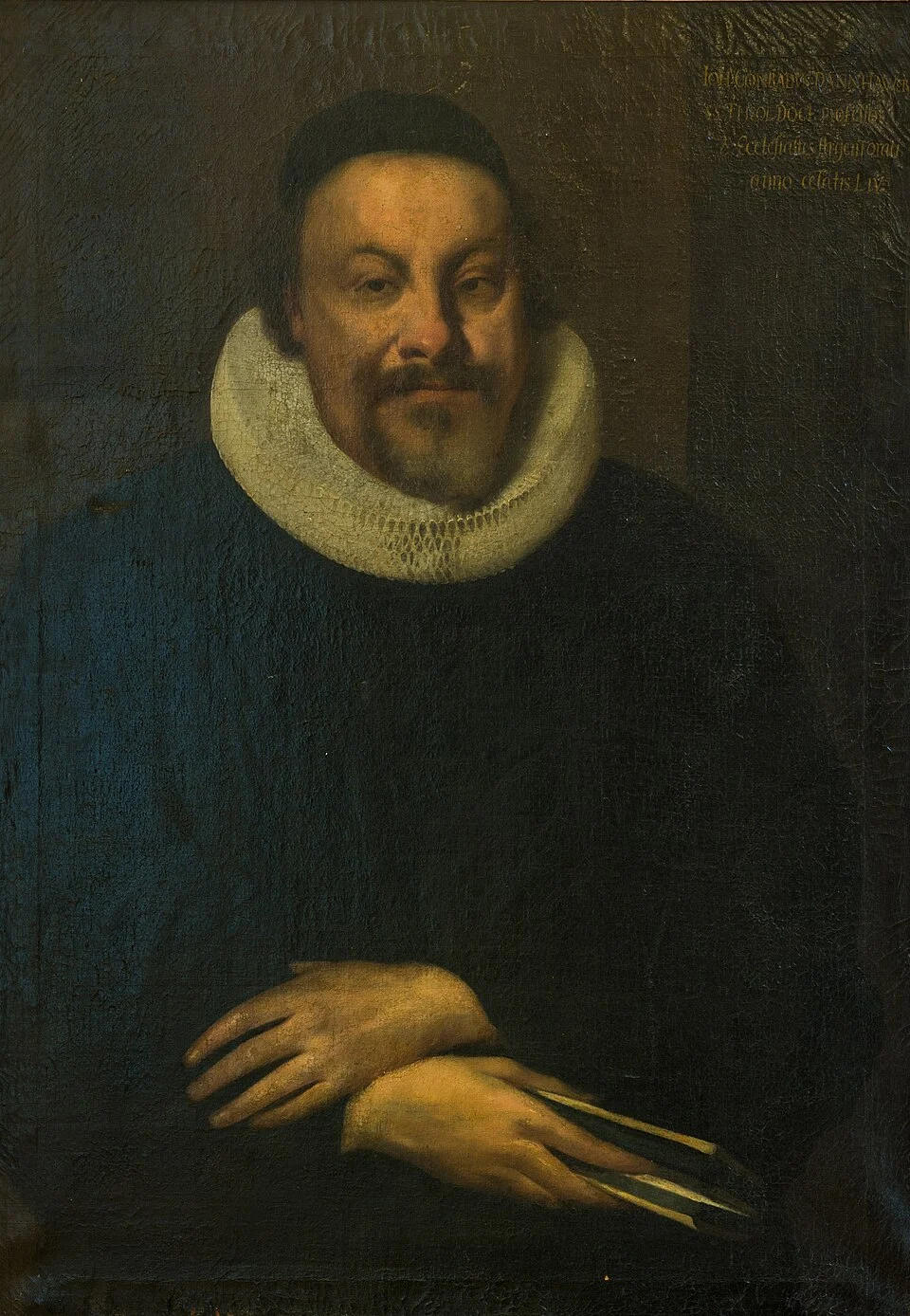
Public domain
Johann Conrad Dannhauer
1603 – 1666
Also known as: Johann Konrad Dannhauer, Johann Christoph Dannhauer, Dannhauer, Johann Conrad
Lutheran — Theology
Johann Conrad Dannhauer (1603–1666)
Johann Conrad Dannhauer was born on January 24, 1603, in Köndringen, in the Breisgau, the region of southwestern Germany near Freiburg. The place mattered less than the moment. He was a child of the confessional age, born into a Lutheranism that had spent two generations defining itself against Rome and the Reformed, and he would grow up inside the Thirty Years' War, which began when he was fifteen and did not end until he was forty-five. His family's circumstances took him early toward the territories where Lutheran learning had its strongest footing, and in his teens he made his way to Strasbourg.
Strasbourg became the center of his life. He studied there at the Gymnasium and the university, and he lingered in the city's intellectual world long enough to be shaped by it: first in philosophy and the humanistic disciplines, then in theology. He took the master's degree in 1624 and went on to further study at Marburg, Altdorf, Tübingen and Jena, the usual circuit for a promising Lutheran scholar of the day. At Jena he met the theology of Johann Gerhard, whose thorough, patristically informed orthodoxy was among the formative influences on his generation. At Strasbourg his teachers included Johann Schmidt and Sebastian Schmidt, and the city's confessional vigor, held in tension with the wartime pressure from Catholic and Reformed neighbors alike, set the shape of his mind.
His career followed the university rather than the parish. In 1629 he became professor of rhetoric at Strasbourg, and in 1633 he moved to the chair of theology, adding the doctorate in 1634. From 1641 he served as pastor of the Münster, Strasbourg's great cathedral, and as president of the city's ecclesiastical convent. The combination was characteristic of him. He taught the next generation of pastors and he was himself responsible for the preaching and church life of an imperial free city that stood at the edge of the war's worst devastation. For more than a quarter century, until his death, he was the leading figure in Strasbourg Lutheranism. Among his students was Philipp Jakob Spener, who would later become the father of German Pietism, a fact that gives the teacher's work a significance he could not have foreseen.
The war and its aftermath marked his world, though the sources are less specific about his own personal losses than about his public labors. Strasbourg itself was spared the destruction visited on many German towns, but it was a city of refugees, of garrison pressure, and of constant theological nerves. Dannhauer's energies went into guarding what he took to be the integrity of Lutheran doctrine. He was a controversialist of the old school: learned, formidable, and unsparing toward those he judged to have strayed. He wrote against the Calvinists, against Catholic apologists, and against the syncretistic efforts of Georg Calixt of Helmstedt to find a wider ground of agreement among the confessions. He regarded Calixt's proposals as a danger to the unity of Lutheran teaching, and he opposed them.
His relation to church authority was that of an insider who defended the structures he served. He was no reformer against the establishment; he was the establishment's theological voice in Strasbourg, and his stance was that of a man tasked with defending an inheritance. Yet the same man cared about pastoral seriousness and the holiness of life in a way that anticipated what would later be called the Pietist concern. He criticized lax practice as sharply as he criticized wrong doctrine, preaching and writing against the corruption he saw in public morals and in the careless use of the sacraments. It was a tension he did not resolve, and it ran through his students into the next century.
Dannhauer died in Strasbourg on November 7, 1666, at sixty-three, after more than three decades in the city's pulpit and lecture hall.
His Writing and Its Influence
Dannhauer's earliest publications came out of the rhetoric chair he took up in 1629, and the humanistic training behind them never left his theological work. His lasting contribution to method came with the Idea boni disputatoris et malitiosi sophistae of 1629, a handbook on the conduct of disputation that distinguished the honest debater from the sophist. It was followed by the Hermeneutica sacra sive methodus exponendarum sacrarum litterarum of 1654, the work for which he is most often remembered. Hermeneutics at that time was largely scattered through the rules of logic and rhetoric. Dannhauer gathered the principles of interpretation into a single, self-standing discipline devoted to Scripture, and the title is among the earliest to carry the word in the modern sense. He insisted that the sense of Scripture was one and determinate, to be sought by grammatical and logical analysis, and he treated the interpreter's task as a matter of method rather than inspiration alone.
His controversial writing was extensive and aimed at the confessions around him. Against Catholic apologists and the Reformed he defended Lutheran teaching on the sacraments and on grace. Against the syncretistic program of Georg Calixt he wrote with particular heat, and his opposition belongs to the long quarrel that divided Lutheran theologians in the mid-seventeenth century. A work he left unfinished at his death, the Liber conscientiae apertus, which dealt with the examination of conscience, is probably the closest he came to a pastoral treatise. Even here the habits of the lecture room and the disputation are plain.
The most characteristic form of his pastoral voice was the sermon. His Katechismusmilch, a large collection of catechism sermons preached over many years in the Strasbourg Münster, ran to numerous volumes and was reprinted into the next century. In it the exposition of the Small Catechism is joined to sharp reproof of laxity in public life and in the use of the sacraments. The same concern appeared in his preaching on the clergy's duties. He held that doctrine untouched by a changed life had failed in its purpose, a conviction he pressed on the congregation of a city under the strain of war.
Much of what he wrote was preserved in the printed disputations, sermons and lectures that Strasbourg's presses produced, and later editions carried his works well beyond the city. His hermeneutics outlasted most of his controversies. Later Lutheran scholars of interpretation, up to and including the age of Pietism and the early Enlightenment, built on or reacted against the framework he had drawn, and historians of biblical interpretation still treat him as a starting point for the field. His standing in his own day was that of a leading orthodox theologian of Strasbourg, ranked among the most formidable Lutherans of the generation after Gerhard.
His influence reached forward through his students. Philipp Jakob Spener, who heard him at Strasbourg, spoke of him with respect and acknowledged the debt even as he moved toward reforms the teacher would not have framed. The concern for pastoral seriousness that Dannhauer expressed in his sermons has been read as one of the roots of Pietism, though he stood within orthodoxy and defended it to the end. Later assessments have tended to divide along the lines of the movements that claimed or rejected him: orthodox Lutherans valued the confessional rigor, historians of Pietism noted the moral earnestness, and scholars of hermeneutics took up the method. His polemical works, bound so closely to the disputes of his own century, have been read far less than the book on interpretation.
Catalog IDA.MF41P5.C