

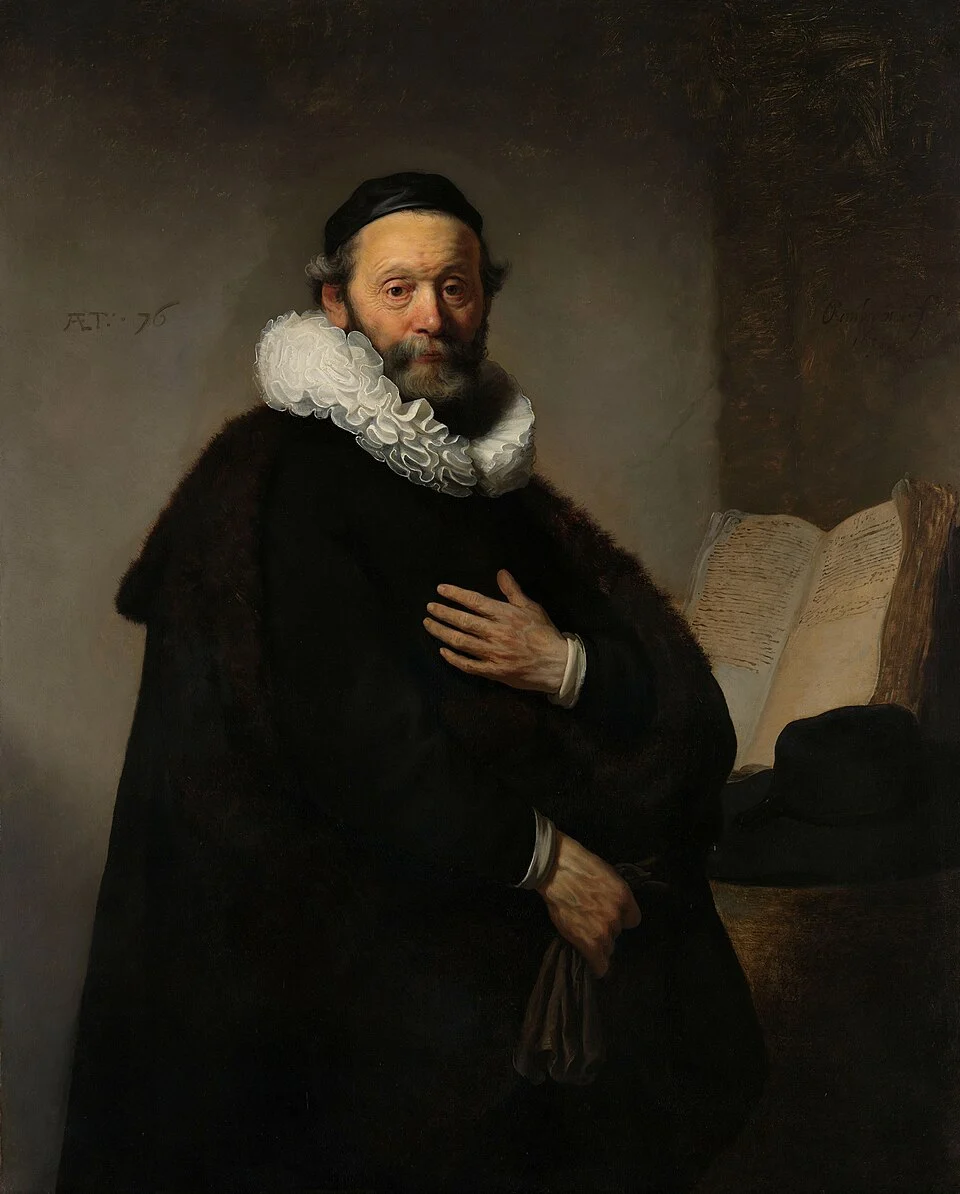
Public domain
Johannes Wtenbogaert
1557 – 1644
Also known as: Jan Uytenbogaert, Johannes Uytenbogaert, Jan Wtenbogaert, Uytenbogaert, Jan
Arminian-Remonstrant — Theology
Johannes Wtenbogaert (1557–1644)
Johannes Wtenbogaert was born on 11 May 1557 in Utrecht, the son of a Catholic family with a long attachment to the city. His father, Joost Wtenbogaert, held a modest civic position, and the household was ordinarily Catholic in practice; Johannes was baptized in the old church, in a city that would soon be pulled into the upheavals of the Reformation and the Dutch Revolt. He received his early schooling in Utrecht before moving on to study at Geneva in the early 1580s, where he came under the influence of Theodore Beza. He later studied at Leiden, where he came into contact with the Reformed professors and with the circle around Arminius, whose thought he would eventually champion and defend.
The Reformed faith he embraced was not inherited but chosen. Wtenbogaert turned from the Catholicism of his family to the Reformed church in his youth, and by 1580 he had been ordained, serving first as preacher in Utrecht. He remained there for several years in the midst of a city divided by competing loyalties. In 1590 he accepted a call to The Hague, the seat of the States of Holland and the center of political life in the young Republic. He would hold that pulpit for nearly three decades. It placed him at the intersection of church and state in a way that shaped everything that followed.
At The Hague, Wtenbogaert became the preacher to the court, and a trusted counsellor to Johan van Oldenbarnevelt, the Advocate of Holland, whose political vision he shared: that the church should remain subject to the authority of the civil magistrate and not govern itself independently of the States. He also served as chaplain to Prince Maurice of Nassau, a relationship that would later turn bitter. His influence on church policy was considerable, and he took part in many of the synods and deliberations that sought to settle the shape of the Reformed church in the Republic. He was a gifted preacher and administrator, and the favor he enjoyed among the magistrates was both his strength and, eventually, his undoing.
The controversy that defined his life was the dispute between Arminius and the strict Calvinists, especially Franciscus Gomarus, over predestination and the nature of grace. Wtenbogaert was Arminius's close friend and ally, and after Arminius died in 1609 he became the effective leader of those who held his views. In 1610 he drafted the Remonstrance, the five articles that gave the movement its name and set out its objections to the prevailing Calvinist doctrine. Alongside the theological questions ran the question of authority: whether the church or the civil government should decide matters of doctrine. Wtenbogaert held that the magistrates should call and direct a national synod, and that the church should tolerate disagreement on the finer points of predestination. His opponents regarded this as a betrayal of the Reformed confessions.
The conflict grew into a political crisis. Prince Maurice sided with the Contra-Remonstrants, and in 1618 he moved against Oldenbarnevelt and his allies. Oldenbarnevelt was arrested and, in 1619, executed. Wtenbogaert, warned in time, had fled the country. The Synod of Dort, which convened in 1618 and 1619, condemned the Remonstrant positions, and he was deposed from the ministry in absentia. He spent the years of exile in Antwerp and in France, in Rouen and Paris, living in uncertainty and without his pulpit. The Remonstrant ministers were banished or silenced, and the movement he had led was driven underground.
When Maurice died in 1625, the climate shifted. His successor, Frederick Henry, allowed the exiles to return, and Wtenbogaert came back to the Netherlands in 1626. He settled in The Hague, where he helped to organize the Remonstrant Brotherhood into a church of its own, with a seminary in Amsterdam, which later attracted Episcopius and Grotius to its cause. He continued to preach and to guide the community until the end of his long life. He died in The Hague on 4 September 1644, aged eighty-seven.
Catalog IDA.X4QJ64.2